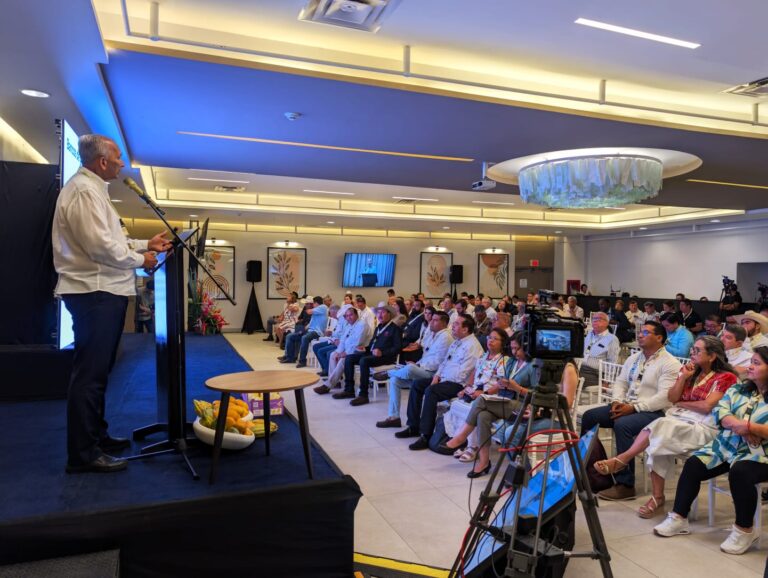
Experts from the Institute and other organizations were taught how to use and apply a methodology that helps reduce postharvest losses in agricultural crops.
San Jose, Costa Rica, 11 November 2015 (IICA). Latin America and the Caribbean (LAC) accounts for six percent of global food losses, and the region wastes fifteen percent of its available food each year.
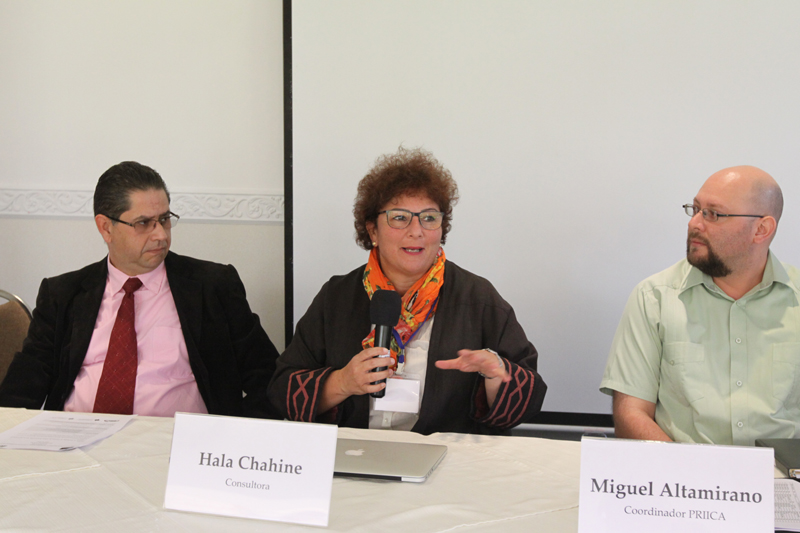
These figures were shared by specialist Hala Chahine, of the Postharvest Education Foundation, at a workshop organized by the Inter-American Institute for Cooperation on Agriculture (IICA) to raise awareness of the issue among the international agency’s senior technical personnel and specialists, and members of the Local Consortia for Agricultural Technology Innovation and Research (CLIITAs) of the Regional Program for Research and Innovation in Agricultural Value Chains (PRIICA) in Costa Rica.
“With agriculture being asked to feed 7.3 billion people, we can hardly afford to waste food. We need to collaborate, create synergies and revisit this issue, especially since IICA was a pioneer in this field for many years,” observed Miguel Ángel Arvelo, IICA’s Representative in Costa Rica, during the opening ceremony of the event.
The 22 participants were trained in the use and application of the Commodity Systems Assessment Methodology for Problem and Project Identification (CSAM), a systematic method for identifying and measuring the factors that lead to postharvest losses, and detecting problems related to the quality of a product in a specific location.
“It calls for a team effort aimed at finding solutions. With this methodology, people are equipped to identify the problems and causes of food losses, such as selection of the wrong product, or inadequate handling, packaging or transportation. Producers also end up losing income and the price of the product rises in the marketplace,” pointed out Chahine, who was responsible for teaching the methodology.
At the workshop, held at the beginning of November, the participants developed skills they can now share with national stakeholders, who will be able to apply the methodology learned. The participants also learned how to draw up proposals for making chains more efficient and reducing food losses.
The event was organized by two of IICA’s flagship projects – Competitiveness and Sustainability of Agricultural Chains for Food Security and Economic Development (“Agricultural Chains”) and Productivity and Sustainability of Family Agriculture for Food Security and the Rural Economy (“Family Agriculture”) as part of their scheduled activities for 2015. PRIICA, an action program in Central America and Panama coordinated by the Institute and financed by the European Union (EU), also took part.
“There are beneficiaries of PRIICA who are losing more than 20 or 30 percent of their production right on their farms. So we can apply the methodology and obtain concrete regional data about what is happening, as well as possible options for improving the situation,” said PRIICA coordinator Miguel Altamirano.
The activity concluded with a field trip. The participants visited the tomato farm and packing plant of the National Association of Agricultural Organizations (ASOPROCONA), located in Heredia, Costa Rica.
More information: