The organizations launched a webinar series in which specialists will analyze the opportunities for agro-digitalization in the Americas.
San Jose, 27 July 2021 (IICA). The key conditions for advancing innovation ecosystems that stimulate the development and application of new technologies to agriculture in the Americas include market access, inventions, a qualified work force, infrastructure and financing. Thus concluded the experts participating in a webinar by the Regional Fund for Agriculture Technology (FONTAGRO) and the Inter-American Institute for Cooperation on Agriculture (IICA).
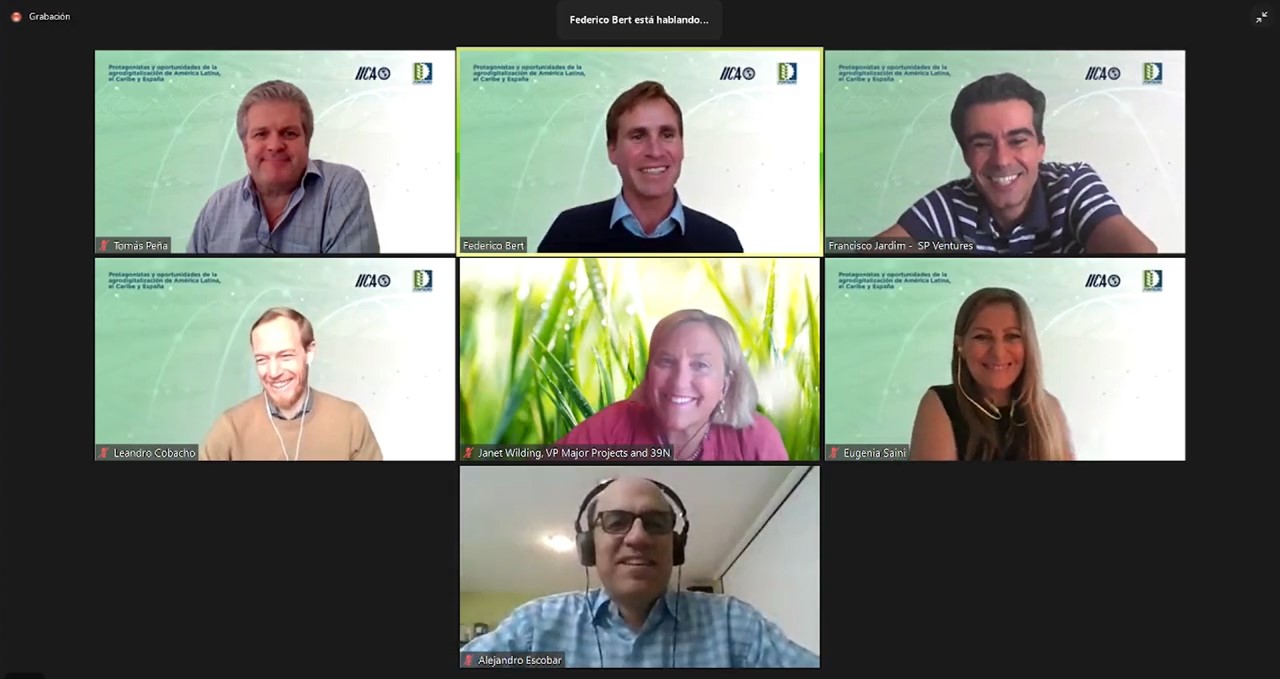
The event, entitled “Development and strengthening of innovation ecosystems”, was attended by Tomás Peña, Director of the technology accelerator Yield Lab LatAm; Alejandro Escobar, Operations and Investments Lead at IDB Lab; Francisco Jardim, Co-founder and Managing Director at the investment fund SP Ventures; Janet Wilding, Vice President of the 39 North Innovation District; Eugenia Saini, Executive Secretary of FONTAGRO; and Federico Bert, Digital Agriculture Specialist at IICA.
“The innovation ecosystem must include five pillars in order to grow. Market access is key—it must be well positioned geographically in order to access farmers. Next are inventions and innovations, which require a sophisticated network of research centers, academic institutions and industry leaders. Third is talent—people who understand the industry, a qualified labor force; and then we have infrastructure and financing”, summarized Wilding.
“The region is lacking in some of these things; however, opportunities exist. I see the pillars as areas in which we need to work, to take advantage of what is already there and of what has greater traction and the capacity to generate traction for agriculture, while understanding that agriculture has different forms and importance within the individual countries”, added Alejandro Escobar from the IDB Lab.
Co-founder of SP Ventures, Francisco Jardim, underscored the fact that innovation is not exclusive to large companies. “In Brazil and Argentina, we are seeing that all the big new innovations in agriculture are not coming from large companies; there are small companies that are incorporating this into crop protection, with eco-friendly products, demonstrating a huge appetite for innovation and change, which is exciting”, he said.
The forum emphasized the need to train more technically skilled and multi-disciplined agricultural professionals. “We need to speak the language of technology, to have the tools necessary to develop on that front and, in the innovation ecosystems, and to create a well-rounded team that incorporates all the necessary disciplines. Only then will it be possible to make headway”, commented Tomás Peña from Yield Lab LatAm.
The session, which was moderated by Saini from FONTAGRO and Bert from IICA, delved deeper into how to reinforce the innovation ecosystems in the Americas to support greater solutions for agriculture and producers and how to facilitate connection and direct communication among key actors in the sector, creating networks and synergies—a key dynamic to drive technological development in agriculture.
“One of the biggest challenges we face is how to bring together all the stakeholders, how to work with regional institutions who have the scientists, as well as with universities and the academic sector, because we know that the agriculture sector is much too fragmented”, stated Saini.
The upcoming sessions of the FONTAGRO-IICA webinar series will address the development and use of specific technologies and the opportunities and challenges for new ventures, and will also continue the discussion on strengthening innovation ecosystems.
“Our goal is to contribute to building and strengthening innovation ecosystems as the main driver of technologies that can improve the livelihoods of farmers and agricultural production. Without a doubt, technological innovation has its hand in everything and agriculture is no exception. The explosion of digital technologies is generating a paradigm shift that is allowing people to create technologies who would never have been able to do so before”, concluded IICA Specialist Federico Bert.
More information:
Federico Bert, Digital Agriculture Specialist at IICA