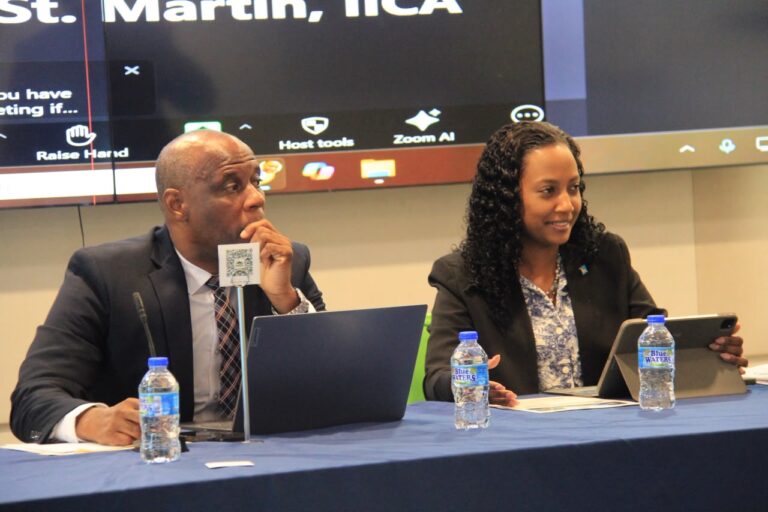
Luis Rosa Pérez, Project Manager for Green SMEs at CAF-Development Bank of Latin America and the Caribbean; Eugenio Díaz-Bonilla, Special Advisor to IICA; Marco Zapata, IICA Representative in Costa Rica; and Carmine Paolo De Salvo, Rural Development Specialist at the Inter-American Development Bank (IDB).
San Jose, 14 October 2025 (IICA)- During a hemispheric dialogue held at the Inter-American Institute for Cooperation on Agriculture (IICA), government leaders, representatives of international agencies and regional agrifood sector experts agreed on roadmaps for strengthening institutional frameworks and coordinating public policies in Latin American and Caribbean countries.
The meeting identified effective governance, strategic public spending and the promotion of innovative green funding as pillars for scaling up solutions to current and future challenges facing agrifood systems in the region.
During the closing session, experts worked together to identify enabling conditions and scalable lessons learned, and analyzed the main obstacles countries in the hemisphere face in scaling up agrifood public policies. Based on this assessment, they generated specific recommendations aimed at strengthening the implementation of more inclusive, sustainable and effective policies.
Participants underscored the need to create platforms for dialogue and coordination between ministries, international agencies, the private sector and civil society to design and implement comprehensive policies and, in turn, achieve effective governance. They also underscored the importance of monitoring and evaluation systems that guarantee transparency and accountability.
Eugenio Díaz-Bonilla, IICA Special Advisor on this issue, emphasized that public institutional frameworks and a transformative governance of agrifood systems requires clear mechanisms for coordination among various stakeholders.
“Governance must involve actions at both the national and local levels, fostering the inclusive participation of rural communities, women and youth in decision-making. A multi-year operational program with defined objectives, instruments, costs and funding sources, supported by a specific budget as well as monitoring and control mechanisms, is also necessary”, stated Díaz-Bonilla.
With respect to public spending, participants agreed on the urgent need to strategically redirect resources towards investments that promote sustainable productivity, innovation and healthy diets.
Carmine Paolo De Salvo, Rural Development Specialist at the Inter-American Development Bank (IDB), explained that enabling conditions include the implementation of smart incentives and subsidies, such as pre-planting support, guaranteed prices and fertilizer programs for small-scale producers.
“Budget transparency and impact assessments allow for demonstrating the real benefits of these measures in terms of sustainability, productivity and poverty reduction”, Giordano concluded.
With respect to green funding, participants discussed the need to establish clear regulatory frameworks that define criteria for green loans, thematic subsidies and other sustainable financing tools.
Participants highlighted the role of financial innovation in developing products such as green loans, renewable energy loans and transparency platforms that allow for reporting on the environmental impact of investments. They also emphasized the importance of strengthening the institutional capacities of banks, regulators and companies to measure, publish and reduce emissions associated with their investment portfolios.
“Financial innovation not only drives sustainability; it also transforms the way we measure and communicate environmental impact. At CAF, we promote instruments such as renewable energy loans which, complemented by transparency platforms, strengthen accountability and trust in responsible investments”, remarked Luis Rosa Pérez, Project Manager for Green SMEs at CAF-Development Bank of Latin America and the Caribbean.
Roadmap
The event concluded with a commitment to advance towards a new generation of agrifood public policies, coordinating efforts and sharing lessons learned.
As part of the roadmap for action, IICA’s Public Policy Observatory for Agrifood Systems (OPSAa) will compile and label the cases and experiences shared during the hemispheric dialogue to facilitate consultation and analysis.
“Giving continuity to these purposeful dialogues is crucial. We must share the results we have achieved and take stock of what we have learned in order to define how best to move forward and how to give meaning to this collective process. Reporting on cases and taking people to see them is not enough; we need a scalability strategy that really works and generates an impact”, stated Joaquín Arias, Coordinator of OPSAa.
More information:
Institutional Communication Division.
comunicacion.institucional@iica.int