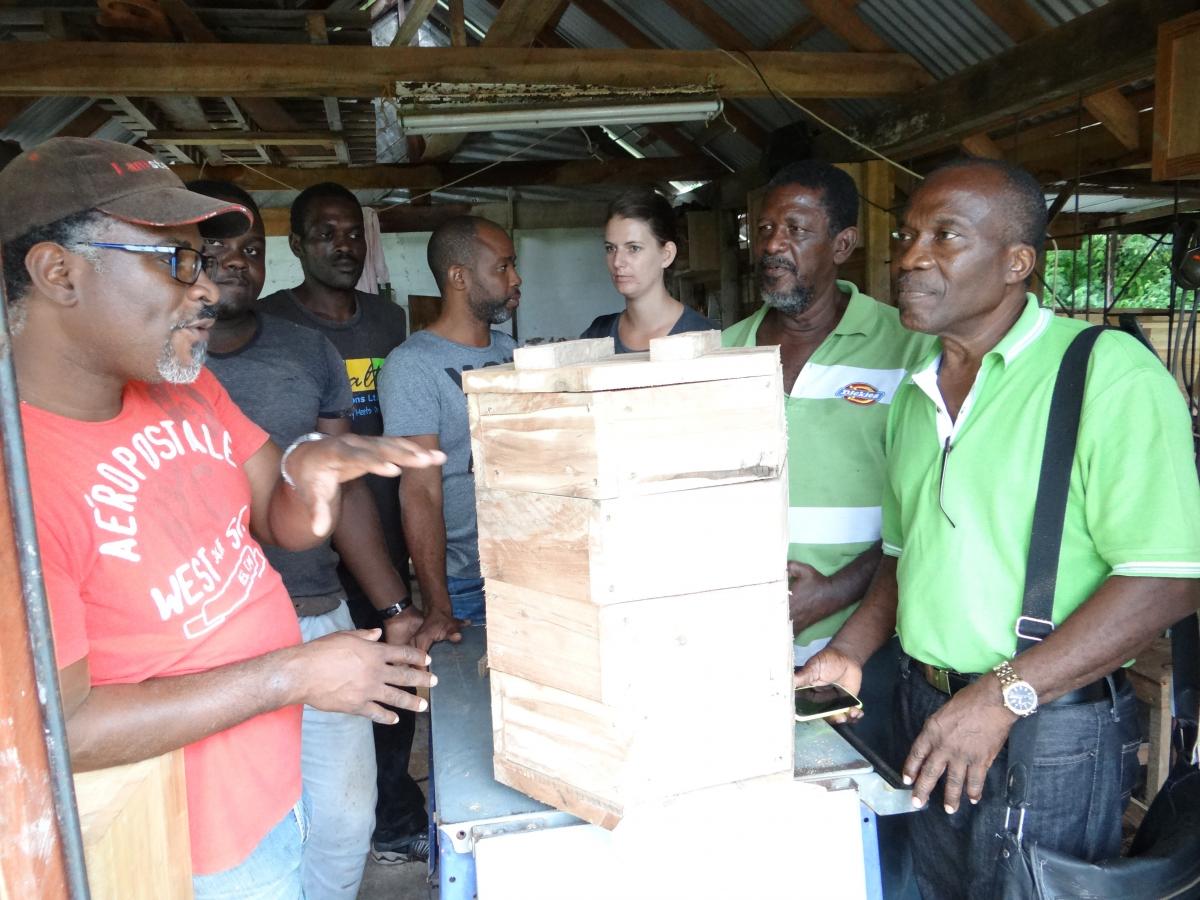
Beekeepers partnering in participatory research to build capacity and knowledge to increase honey yields.

CASTRIES, St. Lucia, November 25, 2016 (IICA). The Delegation in Saint Lucia of the Inter-American Institute for Cooperation on Agriculture (IICA) supported an activity aimed at improving sustainable honey productive intensification and food security.
The initiative was conducted with the purpose of establishing a pilot study to compare production and management parameters between the permapiculture system and the traditional apiculture system (represented by use of the Langstroth hive) on honey farms in St. Lucia.
The activity is a follow-up intervention of IICA’s Family Agriculture Flagship Project which saw more than 30 beekeepers in Saint Lucia trained in 2015 in the construction and management of perone hives in a permapiculture system. This prompted an interest in closer evaluation of the merits of the perone hive as compared to traditional beekeeping practices.
The activity focused on increasing knowledge based on suitable honey production and management practices in order to improve productivity, increase opportunities for differentiation, and reduce losses.
Participants learned about the commercial management of the permapiculture system, and defined the research methodology for a comparative study of the perone and langstroth hives, as well as avenues for improving hive development and commercial honey production.
Also, they were introduced to the management system to follow in each treatment (hive placement, orientation, handling, extraction method, etc.). This will guide the establishment of all hive units for observation.
The technical sessions were facilitated by the IICA Representative in Guatemala, Manuel Sanchez, and was attended by members of the Mille Fleur Honey Producers Cooperative in Saint Lucia, as well as honey producers from Grenada, Saint Vincent and The Grenadines, and Suriname.
For more information, contact: brent.theopile@iica.int