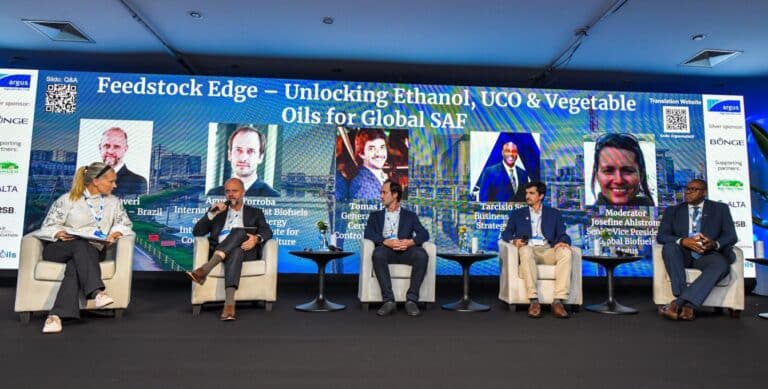

Rosario, Argentina, 28 August 2025 (IICA) –A declaration by the Inter-American Institute for Cooperation on Agriculture (IICA) on the development and promotion of sustainable aviation fuels in the Americas was presented during the Pan American Liquid Biofuels Summit in Rosario, Argentina.
Among the signatories of the Declaration led by IICA are the Latin American Civil Aviation Commission (LACAC), the International Air Transport Association (IATA), the Latin American and Caribbean Air Transport Association (ALTA), the Latin American Energy Organization (OLADE) and the Pan American Liquid Biofuels Coalition (CPBIO).
IICA, as an international organization specializing in agricultural and rural development in the Americas, and CPBIO, created by IICA in 2023 and comprised of the main biofuel producers’ associations and their value chains, acknowledge the transformative potential of sustainable agriculture in supplying feedstocks for the production of Sustainable Aviation Fuel (SAF).
The two entities promote the sustainable development of liquid biofuels as a key tool for decarbonizing the transport sector, and have identified SAF as one of the main strategic opportunities to integrate agricultural and energy value chains and the regional aviation sector.
The aviation sector is facing the urgent challenge of reducing net carbon dioxide emissions from its operations, in accordance with the Long-Term Aspirational Goal (LTAG) adopted by the International Civil Aviation Organization (ICAO) at its Forty-first Assembly, which establishes net-zero carbon emissions by 2050 as a global target.
Across the Americas, there is recognition of the fact that SAF, complemented by technological and operational improvements and carbon offsets, affords a strategic means for achieving the decarbonization goals established by the international community.
The harmonized positions in favor of SAF development, regulation and implementation in Latin America and the Caribbean have been adopted within the framework of LACAC’s mandate to promote regulatory harmonization and technical cooperation among countries in the region, as set forth in Resolution A24-03, which urges the establishment of public policies to incentivize SAF production and use, in keeping with the sustainability criteria adopted by the ICAO Council.
The Joint Declaration announced in Rosario by IICA, CPBIO, LACAC, IATA, ALTA, and OLADE presents a roadmap for coordinated regional action in relation to SAF, with special emphasis on capacity building, infrastructure development, regulatory frameworks and financial mechanisms.
Five points to foster SAF development in the Americas
Following an almost year-long debate process, the aforementioned signatories agreed on the content of the Fourth CPBIO Declaration, which focuses on SAF and consists of five key points:
First, to support and encourage Member States to adopt, develop, and strengthen harmonized regulatory frameworks in accordance with ICAO and LACAC guidelines, to facilitate the establishment of a robust, transparent and competitive SAF market, including certification mechanisms grounded in science, mutual recognition of standards, and technology neutrality.
Second, to support the design and implementation of national and intergovernmental public policies aimed at fostering sustainable SAF production and use, including fiscal incentives, concessional financing, risk mitigation mechanisms for infrastructure investments, subsidy schemes and differentiated pricing.
Third, to reaffirm the need to build sustainable value chains that integrate the agriculture sector, biofuel industry and aviation sector, while also ensuring the supply of certified feedstock, upholding social and environmental justice principles, and strengthening rural economies across the region.
Fourth, to acknowledge the urgent need to mobilize financial resources through the establishment of a multilateral fund for SAF capacity building and production, with the involvement of multilateral credit institutions, regional development banks, international climate funds and public-private partnerships.
Lastly, to commit to fostering close collaboration among the signatories of this Declaration and other relevant national, regional and international organizations in the development of roadmaps for SAF production and use, as well as in the collection of data, assessment of feedstock potential, impact analysis, and technical support for policy formulation.
The signatories reaffirm that SAF development, through inter-governmental cooperation and collaboration, affords a strategic opportunity to simultaneously advance the environmental sustainability goals of the aviation sector and the productive transformation of the agriculture and energy sectors.
Both IICA and CPBIO consider that cooperation and collaboration among governments, producers and the private sector will be key to facilitating a smooth, equitable and effective transition towards a net-zero carbon future for air transportation in the Americas.
According to Agustín Torroba, IICA Biofuel Specialist and Executive Secretary of CPBIO, SAF are the aviation sector’s best bet for meeting its climate commitments.
“The agriculture and aviation sectors will be key strategic partners in the production of SAF, especially in the Americas, enabling our region to become a global hub for SAF production”, he concluded.
Link to the Declaration: https://repositorio.iica.int/items/a78cbaf8-54c1-435a-82fb-913609401ebf
More information:
Institutional Communication Division.
comunicacion.institucional@iica.int