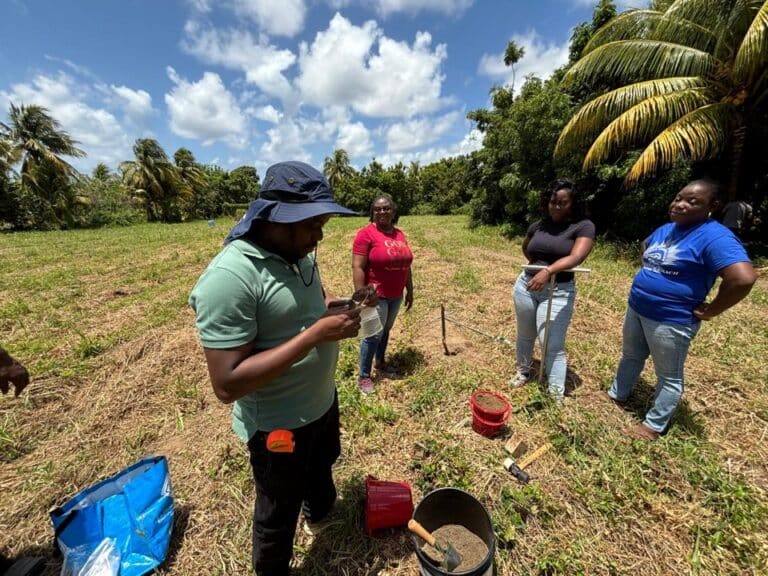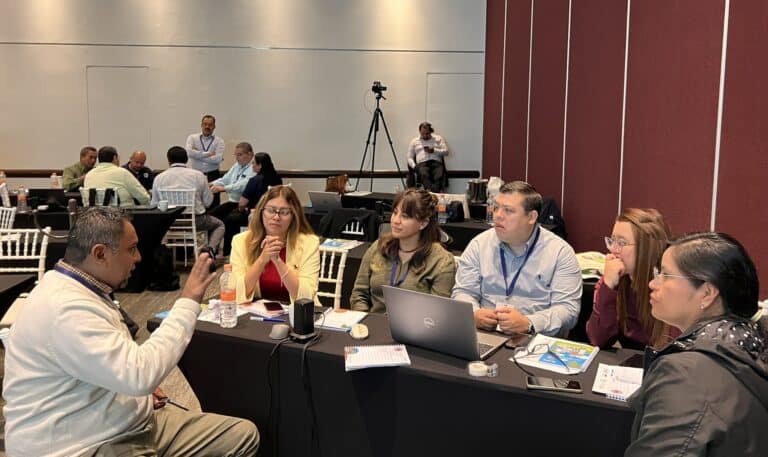
Some 40 representatives of organized groups in Central America, Belize and the Dominican Republic met in Costa Rica to share experiences and participate in training related to rural development.

San José, Costa Rica, September 23, 2011 (IICA). The inhabitants of Rio de Jesús, a 316- square- kilometer area of the province of Veraguas, Panama, are surrounded by a wealth of diversity, but the land is not the source of the livelihoods of most of them.
Being mostly swampland and marshes, the soil there is infertile and unsuited for growing crops. Cesar Ortiz, an inhabitant of the area, said “We produce some rice, but most of us depend on artisanal fishing for our livings.”
Rio de Jesús was one of the nine territories represented at the First On-site Meeting of the Second Central American Course on the Management of Rural-Area Based Development, held at IICA Headquarters from October 19-23.
At the meeting, 38 local leaders from the public and private sectors of Central America, Belize and the Dominican Republic participated in training related to rural-area based development, in which communities make decisions to ensure their economic, social and environmental sustainability, following general guidelines set by the governments of their countries.
“Rural-area based development can become a reality when the necessary human talent, political will and investment come together,” according to Byron Miranda, Manager of the Agriculture, Territories and Rural Well-being Program of the Inter-American Institute for Cooperation on Agriculture (IICA).
The training course was organized by IICA and the Jose Simeon Cañas University of El Salvador, with support from the Executive Secretariat of the Central American Agricultural Council (SECAC), the Spanish Agency (AECID), the ETEA Foundation and other contributors.
The course was offered within the framework of the Central American Strategy for Rural-Area based Development 2010-2030 (ECADERT), and is intended to develop rural development capabilities in territories defined by each country of the region.
Some of the territories represented were Valle de Sensenti, in Honduras, Rabinal, in Guatemala, Belize River Valley and the North-North region of Costa Rica (Upala, Guatuso and Los Chiles).
IICA Specialist in Agriculture, Territories and Rural Well-being, Mario Samper, explained that in the first semester of 2012, the representatives of these areas must present preliminary plans for their development, involving in their preparation the territorial action groups currently being formed.
Visions of development
In Rio de Jesús, Panama, economic activities and cultural expressions intermingle. An example is the Mi Ranchito festival, to be held for the seventh year this November.
Cesar Quiros, an official with the group in charge of the festival stated “It provides an opportunity to share our culture with others, sell our products and promote tourism.”
Jose Luis Arze, an IICA Rural Development Specialist, added “Identity is at the heart of territorial management; territories are not created by decree, they are built.”
Jorge Leon, a SECAC consultant, said “As regards the management of development, grassroots organizations can become leaders of rural change.”
In his opinion, in Central America and the Dominican Republic, non-agricultural rural sectors (trade, construction, transportation, tourism, for example) have had the strongest economic growth in recent years due in part to the fact that governments have not invested in research and development.
“Agricultural innovation depends of innovative producers, he added.”
He went on to say that there is a multisectoral movement under way today to restore the importance of agricultural development in the region, as means of combating poverty and ensuring food security, economic growth and the preservation of the environment.
The participants in the course were of the opinion that rural-area based development could work in their territories because, in most of them, there are the necessary state institutions , organized civil- society groups and environmental and cultural riches.
Juan Diaz, from an association of shrimpers in Valle del Jiquilisco, El Salvador, said “We have many opportunities; all we need is funding. A hefty investment will be needed to get started.”
For more information, contact:
mario.samper@iica.int