
San Jose, 15 October 2025 (IICA) – In a bid to strengthen the region’s role in international agricultural trade—a critical area for its food security and development—the Inter-American Institute for Cooperation on Agriculture (IICA) launched an academic program to enhance the ability of public officials to negotiate in bilateral, regional and multilateral forums.
The program, “The Itinerant Chair in International Agrifood Trade for the Countries of the Americas”, will offer specialized, practical and state-of-the-art training, aimed in particular, but not exclusively, at professionals in the ministries of Foreign Affairs of IICA member countries.
The initiative stems from the premise that ministries of Foreign Affairs play a key role in formulating and defending their countries’ positions on trade, serving as official spokespersons in negotiation processes and in the application of international trade agreements.
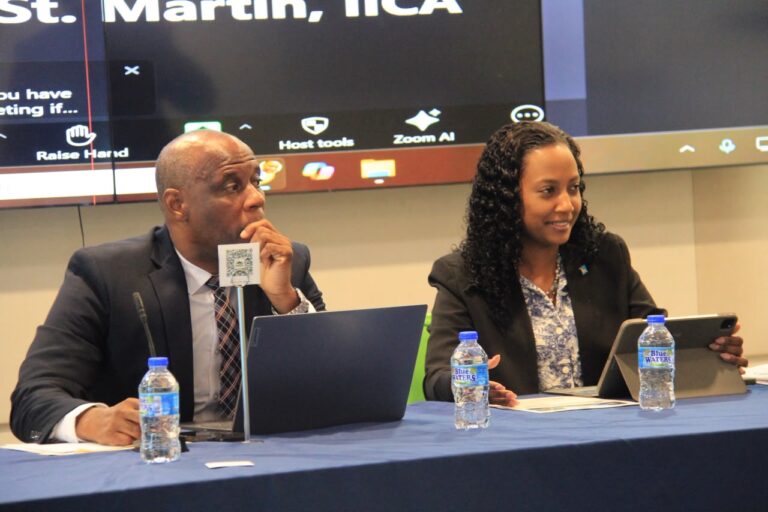
The Chair initiative was presented at a hybrid—in-person and virtual—event, attended by close to two hundred persons, including ministers of Agriculture, deputy ministers, senior officials from the Foreign Affairs ministries, ambassadors, academic directors of diplomatic training institutes and private sector officials involved in the food export trade.
Deputy Minister of Agriculture and Livestock of Costa Rica, Fernando Vargas; Director of Protocol in the Ministry of Foreign Affairs and Worship of Costa Rica, Ambassador Michel Chartier; Director of the Trade Agreement Office (OTCA) of the Ministry of Agriculture of the Dominican Republic, Viktor Rodríguez; and the Director General of IICA, Manuel Otero, spoke at the opening of the event.
The Minister of Agriculture of Grenada, Lennox Lewis, and the Mexican Ambassador to Costa Rica, Víctor Sánchez, were among those attending the event.
Martín Piñeiro, Director General Emeritus of IICA and Director of the Committee on Agriculture of the Argentine Council of International Relations (CARI), and Franklin Marín, Coordinator of IICA’s Center for Knowledge Management and Horizontal Cooperation Services,spoke about the challenges and opportunities in international trade negotiations.
Daniel Rodríguez, Manager of IICA’s International Trade Program, explained the details of the Chair initiative, and María Febres, IICA Chief of Staff, served as the moderator of the subsequent discussion among the participants.
Partnerships that benefit agriculture
The Chair initiative will seek to improve understanding of regulatory frameworks, develop negotiation skills and assist in enhancing interinstitutional coordination, which are essential elements in ensuring the effective and competitive participation of the agrifood sector in regional and international markets. In the agrifood sphere, these issues are particularly relevant, due to the growing complexity of international trade regulations,the sensitivity of agricultural products and the need to broker sectoral and national interests to develop a strategic vision for the country.
Deputy Minister Vargas commended IICA on its innovative initiative to build technical knowledge on international market access for the region’s agrifood production.
He noted that, “The countries need to have international representatives that are giving some thought to the importance and difficulties of their job and that commit to forging partnerships that benefit the food production sector in our countries”.
“The Chair program will ensure that our international missions can discuss agricultural production in our countries with knowledge, sensitivity and a clear idea of the agriculture sector that we envision for the future”, he added.
On the other hand, Michel Chartier, from the Costa Rican Ministry of Foreign Affairs, stressed that IICA’s efforts, and particularly the aim of the Chair, were “more important than ever in a world in which the greatest challenge was strengthening multilateralism. As diplomatics, we are extremely grateful for these types of training initiatives”.
The central importance of the Chair became clear in Martín Piñeiro’s presentation on the opportunities and challenges involved in strengthening the agrifood trade of the Americas amidst an ever-changing international context.
Piñeiro spoke about the need for Latin America and the Caribbean to expand markets, diversify export products and work to reduce inequalities between the exporting and importing countries of the region, while also increasing inter-regional trade.
“For years, international trade has operated by different rules than World Trade Organization (WTO) rules. We need imagination and creativity to respond to these changes. Global food demand will continue to increase, as there are more people with purchasing power, who are consuming more and demanding more products and variety. Thus, there are opportunities, which will increase in the future, but the institutional and geopolitical framework will probably become more complicated. There are already difficulties today, which will only increase. We must prepare to overcome them”, said Piñeiro.
Otero expressed the view that international trade was the main factor determining the level of food security and as such stressed the role of Latin America and the Caribbean, as a region accounting for one in every four tons of food produced in the world and one in every three tons of food exports.
“The ministries of Foreign Affairs”, he said, “should have negotiators equipped with sufficient capacities and expertise, because regulations are increasingly complex and also call for complementarity between the public and private sectors. Today, we are offering this Itinerant Chair program, designed to offer specialized, practical and state-of-the-art training to ministry officials and other key individuals involved in agricultural trade policy. We are seeking to open doors to new markets and to democratize knowledge, to assist IICA member countries, enabling them to transform the challenges facing our region into opportunities”.
More information:
Institutional Communication Division.
comunicacion.institucional@iica.int