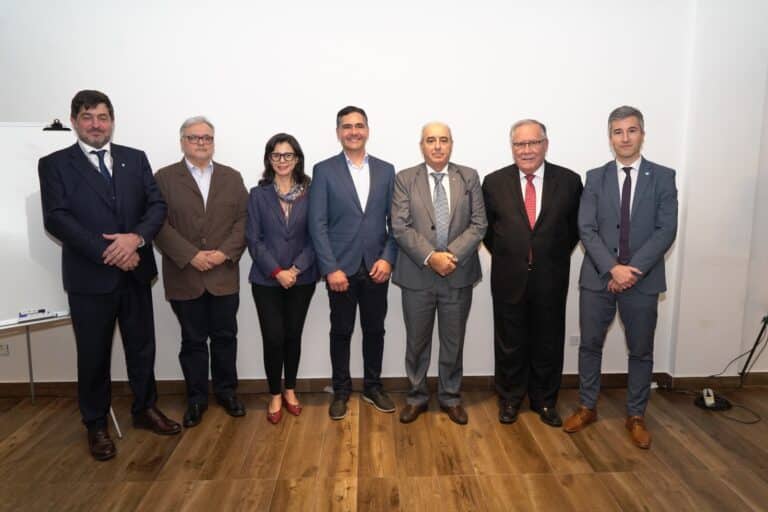

Manuel Otero, Director General of IICA, and José Urdaz, Manager of IICA’s Agrifood Health and Safety Program.
San José, 22 October 2025 (IICA) – The Inter-American Institute for Cooperation on Agriculture (IICA) has unveiled the updated version of a key tool designed to modernize and strengthen agricultural health and food safety services across the Americas—an initiative aimed at safeguarding the region’s sanitary and phytosanitary status, ensuring safe food trade, protecting public health, preventing economic losses and driving rural development.
The 2025 digitalized and updated version of the Performance, Vision and Strategy (PVS) tool was presented during a webinar organized by IICA’s Agricultural Health, Safety and Agrifood Quality Program (AHFS), which brought together over 200 participants from across the region.
Developed by IICA in 2005, the PVS tool has been applied more than 70 times in 30 countries.
The new version incorporates the One Health approach within agri-food systems, which integrates the health of people, animals and the environment. It also introduces a modernized web-based application that enhances accessibility and participation, delivers real-time results, streamlines data analysis and presents findings in a user-friendly, visual format.
Thus, the IICA-created PVS is more than a management instrument—it contributes to building modern and resilient phytosanitary services. The tool fosters intersectoral coordination and strengthens strategic planning within official agricultural health services, which are crucial for sustainable development, compliance with food export market requirements for countries of the Americas and expanded access to new markets.
Regional leadership and responsibility
The webinar to present the 2025 PVS tool was led by IICA Director General Manuel Otero and SAIA Program Manager José Urdaz.
Technical specialists Alejandra Díaz, Rodrigo Astete, Susana Miranda, Ana Marisa Cordero and Horrys Friaca described the modernization process and explained the tool’s operation, while international consultant Jaime Flores Ponce discussed the broader impact of modernizing agricultural health and food safety systems in the Americas.
At the webinar, the updated 2025 PVS was described as a dynamic modernization and strategic planning tool designed to strengthen the critical competencies—both technical and operational—of national agricultural health services.
The tool assesses the institutional and operational capacity of these services across four components: technical capacity (related to the quality of labs to ensure the accuracy and reliability of data), human and financial capital (the importance of skilled staff and adequate budgets), stakeholder engagement (including consumers) and the protection of public health and market access.
Otero highlighted that, as the world’s leading food-exporting region, the Americas bear both prominence and responsibility in ensuring global food security. “We must supply abundant, nutritious, affordable and high-quality food produced with respect for the environment. To achieve this, our agri-food systems must undergo constant transformation, and modernizing sanitary protocols is essential”, he stated.
“IICA”, he added, “is a service provider. I witnessed the creation of the PVS tool, which has had a remarkable positive impact on agricultural health services across countries, and it has now been modernized to meet the demands of our times”.
Urdaz noted that the new web-based PVS version was recently and successfully implemented in Panama. “IICA’s commitment is to continue enhancing it to protect human, plant and animal health—deeply interconnected areas—and to contribute to a safer, more sustainable hemisphere, where food trade supports food security and socio-economic development”, he said.
Flores Ponce pointed out that risks in agricultural health are constant and evolving. “This is not a static issue. We face the challenge of ensuring that national services are prepared to minimize risks and build trust among counterparts. We cannot overlook the importance of protecting public health and maintaining sanitary status, which is crucial for safeguarding export markets and opening new ones”, he stressed.
The Ecuadorian expert acknowledged the diversity within the region: while some countries have robust systems with measurable indicators and goals that inspire confidence, others face serious infrastructure limitations and outdated regulatory frameworks.
“This disparity creates vulnerabilities that affect competitiveness. The lack of reliable systems can lead to trade restrictions and significant economic losses. It is vital to develop state policies grounded in technical and scientific evidence and sound risk analysis. Institutional modernization is impossible without technology and digitalization. We need regional cooperation and networked collaboration—no country can face these global challenges alone”, he concluded.
More information:
Institutional Communication Division.
comunicacion.institucional@iica.int