The Government of Mexico, IICA, the CICY (Mexico) and the University of West Indies at St. Augustine (Trinidad and Tobago) pool efforts to promote innovation and research in 13 Caribbean nations.

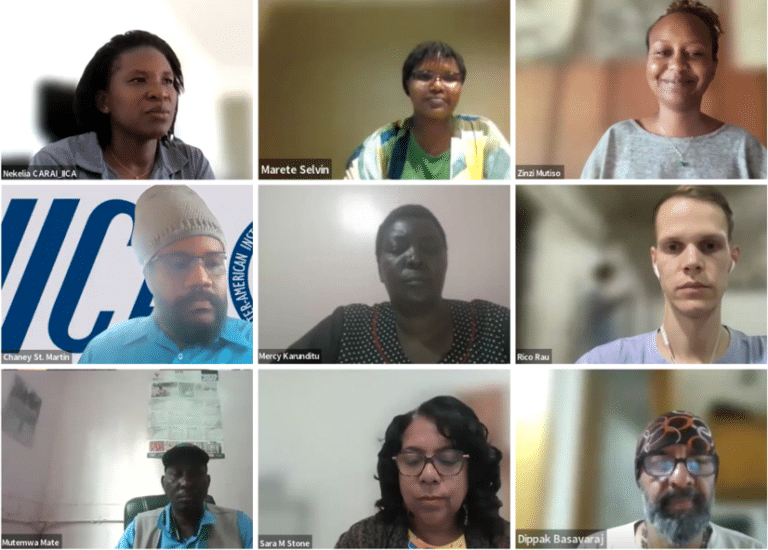
Trinidad and Tobago, June 22, 2015 (IICA). Technical personnel working in 13 Caribbean countries have new tools for promoting in vitro cloning of tropical plants, thanks to an initiative promoted by the Government of Mexico that is being carried out with support from the Inter-American Institute for Cooperation on Agriculture (IICA).
Based on the expertise they have just acquired, the participants expect to prepare a protocol on in vitro cloning for use in their respective countries of origin. The experience and parameters established by the Scientific Research Center of Yucatán (CICY), the facilitator of the training event, will be used to develop the protocol.
The initiative forms part of the program Capacity building for the development of agriculture in Central America and the Caribbean, a joint effort involving IICA and Mexico’s Secretariat of Agriculture, Livestock, Rural Development, Fisheries and Food (SAGARPA).
The course, led by CICY specialists with support from the Faculty of Food and Agriculture of the University of West Indies (UWI), was held in Trinidad and Tobago in mid-June.
The UWI Campus Principal, Prof. Clement Sankat, underscored the importance of these efforts for research and for creating better technology transfer mechanisms, two points of strategic importance to the university.
The Dean of the Faculty of Food and Agriculture, Isaac Bekele, noted that one of the most attractive aspects of the training was to show the participants the economic potential of agriculture.
The countries taking part were Antigua and Barbuda, Grenada, Jamaica, St. Lucia, St. Kitts and Nevis, Bahamas, Guyana, Suriname, St. Vincent and the Grenadines, Belize, Barbados, Dominica, and Trinidad and Tobago.
More information:
franklin.marin@iica.int
Related notes: Mexico to increase cooperation for agriculture in Central America