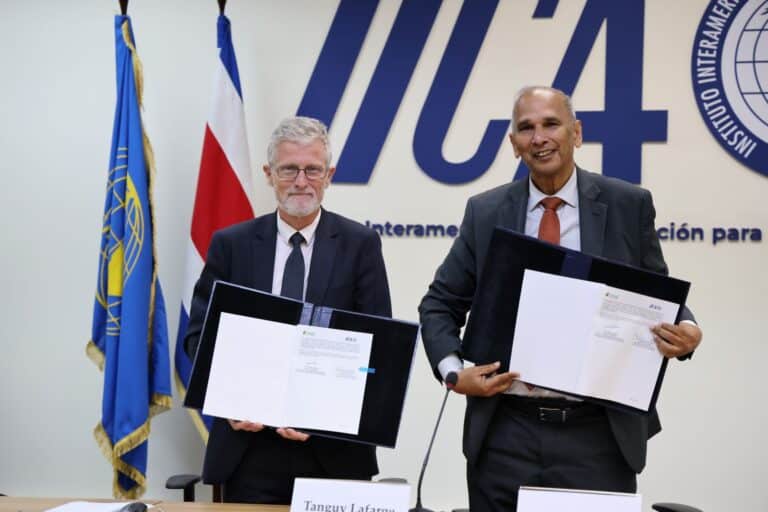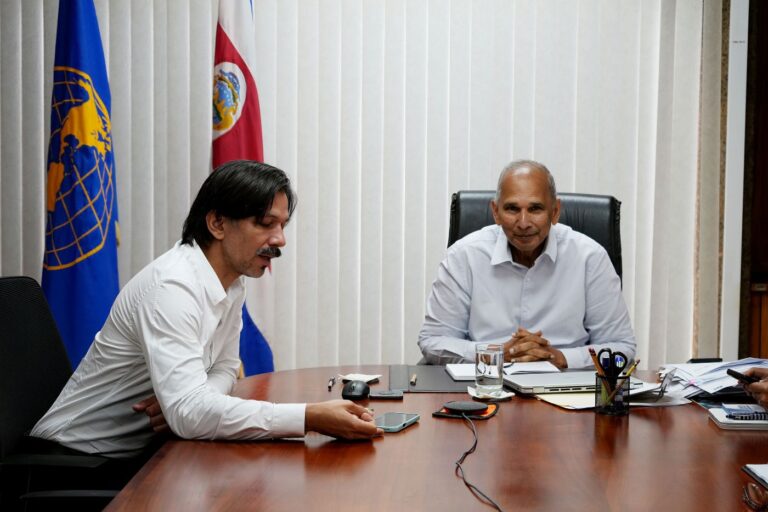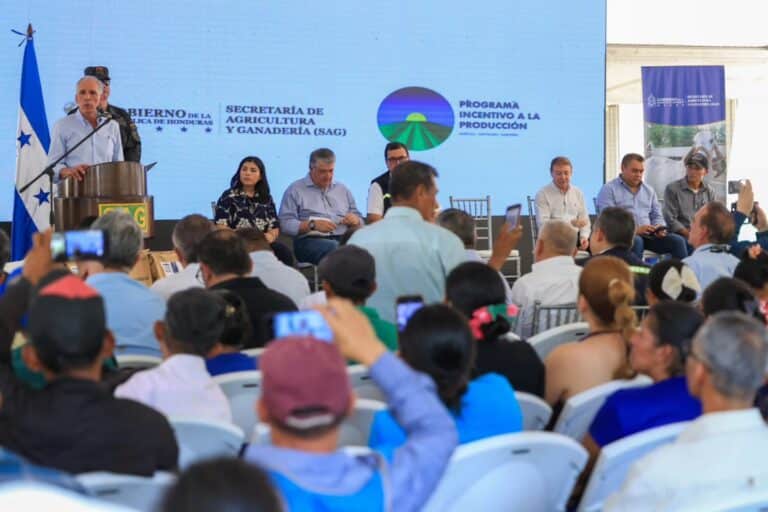
The signing of the association agreement between both organizations was signed in the presence of witness of honor, Michael Kremer, Harvard Professor and 2019 Nobel Prize winner for Economics.
San Jose, 23 June 2020 (IICA). Precision Agriculture for Development (PAD) and the Inter-American Institute for Cooperation on Agriculture (IICA) have announced that they will partner to drive the digitalization of agriculture in Latin America and the Caribbean, primarily to benefit rural smallholder farmers. PAD is a non-profit organization, co-founded by 2019 Nobel Prize winner for Economics, Michael Kremer.
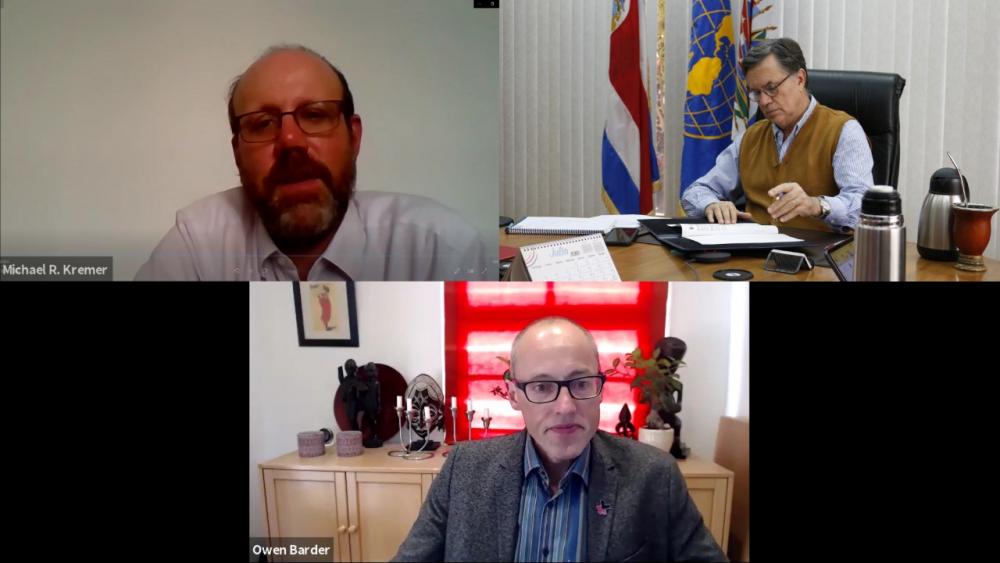
The association agreement aiming to boost the output and sustainability of agricultural production in the region, was signed by Owen Barder, Executive Director of PAD, and Manuel Otero, Director General of IICA, during a virtual meeting, in the presence of economist Michael Kremer, who served as witness of honor.
Kremer, a Gates Professor at Harvard University, was co-recipient of the 2019 Nobel Prize for Economic Sciences with his colleagues Abhijit Banerjee and Esther Duflo, for their experimental approach to alleviating global poverty. In 2015, Professor Kremer co-founded PAD with Shawn Cole, Dan Björkegren and Heiner Baumann, to advance research undertaken through pilots in India and Kenya which had demonstrated the impact that digital agriculture could have on the income and productivity of small farmers.
After the signing, Kremer said: “Is a very strong alliance of interests, it’s wonderful to see how quickly both organizations have been able to work. Obviously the next step is turning that into reality on the ground, so we can achieve our objectives”.
PAD harnesses the power of technology, data science and behavioral economics to provide targeted information to farmers to improve their lives. By providing actionable information to the right people, in the right way and at the right time, PAD empowers smallholder farmers with personalized agricultural advice – delivered to their mobile phones – to improve their productivity, increase their profitability, and advance environmental sustainability.
PAD currently works in eight countries in Africa and Asia. As of the end of the first quarter of 2020, PAD had reached 3.6 million farmers through a range of services at a cost of approximately 1.46 dollars per producer.
Studies undertaken by PAD have shown that these services are extremely cost-effective, with point estimates suggesting a benefit-cost ratio between 6:1 and 10:1 – very high relative to other development interventions.
At a time when traditional in-person agricultural extension services have been scaled back or suspended due to social distancing protocols and the impact of the pandemic, digital services continue to assist farmers by delivering information directly to people. Digital extension services enable low-cost, high impact and two-way communication capable of empowering producers at scale, despite the impacts of the pandemic.
The PAD-IICA agreement will facilitate the joint implementation of these strategies, in a bid to modernize agriculture and bridge the gaps in Latin America and the Caribbean.
Manuel Otero, Director General of IICA, remarked that, “The application of information and communication technologies in agriculture is increasingly putting us on the path to a digital agricultural revolution. These tools will be pivotal in enabling us to produce more and better food, as well as to increase the sustainability of the sector and the efficiency of natural resource use”.
Furthermore, he explained that, “This association will also assist us in bolstering our efforts to mitigate rural flight and its negative consequences, and thus it also stands to have a great impact on cities”.
Owen Barder, Executive Director of PAD commented that “Working together, we can accelerate the future. A majority of the world’s poorest people are smallholder farmers. By reaching them with information and advice, we can enable them to increase their incomes. Digital services are cheap, effective and scalable. By closing the digital divide, we can help reduce poverty, close the inequality gap, and protect the planet for future generations. We are delighted to partner with IICA to drive digital agriculture in Latin America and the Caribbean”.
IICA is fostering greater productivity, competitiveness, sustainability and inclusion in agriculture in the Americas, as well as the development and well-being of its rural territories.
In response to the Covid-19 pandemic, the IICA has adjusted its cooperation model to provide producers and countries of the region with tools to strengthen agricultural activity, which is key to ensuring the food and nutritional security of the entire population.
It has also forged new strategic alliances to offer technical cooperation of excellence and consolidated its role as a bridge between countries, organizations and agricultural research agencies, with a view to ensuring greater recognition and positioning of agriculture as a fundamental economic driver for post-pandemic recovery.
In a recent videoconference between Michael Kremer and Manuel Otero—streamed online in English, Spanish and Portuguese—the 2019 Economic Sciences Nobel laureate noted that, “The current pandemic is an ideal time to begin investing in digital extension, which is an effective means of supporting farmers during the spread of Covid-19, while also laying the groundwork for a very valuable long-term system”.
Manuel Otero, Director General of IICA, Michael Kremer and Owen Barder impressions after signing the agreement:
More information:
Institutional Communication Division, IICA.
comunicacion.institucional@iica.int