
Panama City, Panama, 30 April 2025. At the 17th International Gas & Energy Forum (IGEF), held in Panama City under the theme “Ensuring Energy Security with Reliable Sources”, the participants focused on the transition towards more sustainable sources and innovation in decarbonization, considering all energy sources, from hydrocarbons to renewable energies, green hydrogen, electromobility and the critical minerals needed for the transition.
The event was attended by representatives of key stakeholders from the public and private sectors, multilateral organizations, and important regional companies, including Juan Manuel Urriola, Panama’s Energy Secretary, and Andrés Rebolledo, Executive Secretary of OLADE, the Latin American Energy Organization.
A forum with expert voices
The 2025 IGEF included discussions on the strategic role of oil and gas in the global transition, the future of biofuels, and the development of minerals of critical importance for emerging technologies; and also provided an opportunity to share the experiences of different companies with the evolution of the energy sector in the region.
The event also explored the impact of low-carbon and carbon capture, utilization, and storage (CCUS) technologies, the expansion of electromobility, and the role of green hydrogen as a key source for the future of energy.
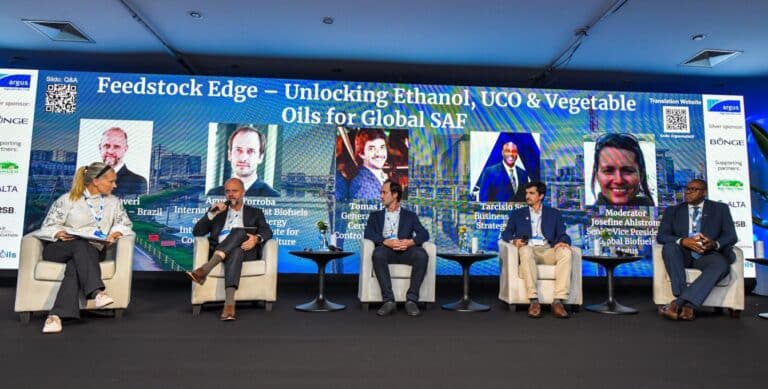
Agustín Torroba, an international biofuels expert from the Inter-American Institute for Cooperation on Agriculture (IICA) and executive secretary of the Pan-American Liquid Biofuels Coalition (CPBIO), spoke about the evolution of biofuels and emphasized the great potential that exists to produce abundant quantities of sustainable raw materials that can be processed to replace gasoline and imported diesel, and, in the near future, to produce SAF (sustainable aviation fuel) and marine fuels.
Carlos Gratelón, from Colombia’s Biofuels Federation, stressed the importance of communicating how biofuels are already decarbonizing land transportation and replacing fossil fuels.
“More than 80% of Colombia’s regulations are now related to the use of biofuels, and we are beginning to decarbonize air transport using SAF”, Gratelón added.
“It is important to point out that the country hosting the Congress, Panama, is making progress toward the mandatory use of 10% bioethanol in gasoline”, Torroba concluded.

During his participation in the 17th International Gas & Energy Forum, Agustín Torroba highlighted the opportunities for the Americas to spearhead the production of sustainable biofuels, the key to replacing gasoline, diesel and aviation fuels.
More information:
Institutional Communication Division.
comunicacion.institucional@iica.int