
Belém do Pará, Brazil, 21 November 2025 (IICA) – Profitability, collaborative work and public policies are three key elements to support agriculture that not only conserves natural resources, but also restores degraded environments, said private sector and civil society actors at COP30.
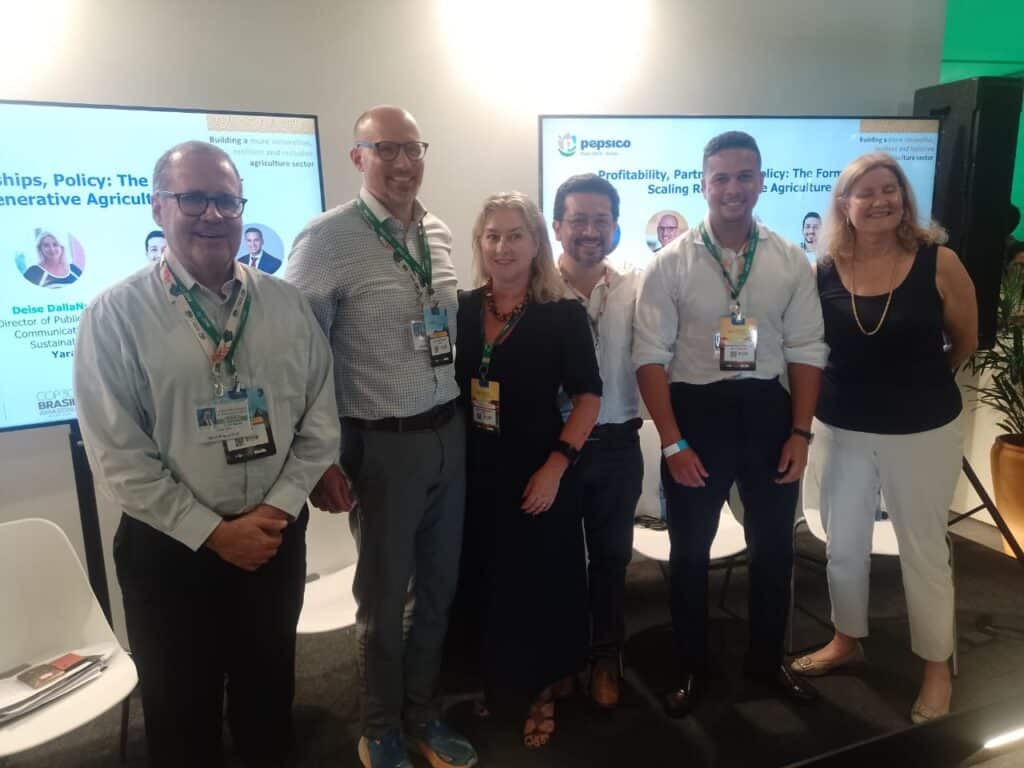
The pavilion set up by the Inter-American Institute for Cooperation on Agriculture (IICA) in Belém do Pará—where the world’s largest environmental forum is taking place, attracting more than 50,000 people—hosted a discussion on the most appropriate incentives to promote regenerative agriculture.
Participants included Dan Christenson, Vice President for Public Policy at PepsiCo, one of the world’s leading food companies; Deise DallaNora, Director of Public Affairs, Communications and Sustainability at Yara, a global leader in crop nutrition and provider of environmental and agricultural solutions; Juan Carlos Francisco Guillén, Ecological Engineer and President of the Mexican civil association Cecropia; and Kyle Bridgeforth, owner and operating partner of Bridgeforth Farms, a productive enterprise that has spanned five generations in the state of Alabama, in the southern United States. The moderator was Lloyd Day, IICA Deputy Director General.
Participants agreed on placing farmers’ needs at the center of the discussion and stated that it is necessary to expand approaches that reward those who carry out good agricultural practices which, in turn, offer ecosystem benefits.
PepsiCo and Yara announced this year that they have entered into a strategic partnership to reduce greenhouse gas emissions in agriculture. The program concerns PepsiCo’s agricultural supply chain and benefits potato producers in Mexico, Colombia, Chile and Argentina in its initial phase. Its expansion is expected later in Latin America to include a variety of additional crops such as corn, wheat, oats, coconut and plantain.
Success today and 50 years from now
“We know very well that it is essential to work with farmers and make sustainability a priority in order to succeed now and in 50 years. On the path to scaling regenerative agriculture, commercial incentives, agronomic innovation and policies that facilitate good practices are crucial”, said Christenson.
The PepsiCo executive considered that the first step is to thoroughly understand realities in the territories: “Grand policies begin by just listening and understanding. Only under those conditions can scaling take place. There are farmers in Latin America and the Caribbean creating value in terms of low emissions, water stewardship or restoring soil health, and that must be rewarded. We have great experiences that show that incentives work. We need more companies doing this and also clearer signals from governments”.
Deise DallaNora, an Agronomy and Agroecology specialist at Yara in Brazil, described ways to improve sustainability in tropical agriculture with low-cost inputs and efficient nutrient use. She also spoke about how to support farmers to access markets and how to attract financing for sustainable practices.
“It is very important to take part in public-private initiatives. In Brazil we do so to restore degraded lands. Concerning private actors, the partnership between PepsiCo and Yara is long-term. It began in Europe, then moved to Latin America, and we are talking about valuable creation. But we know that in order to reward farmers for their environmental services, especially in developing countries, we need more collaboration with the public sector”, she said.
“In Chiapas, we combine science, technology and local knowledge to protect water, conserve natural resources and safeguard the peoples living in the territories”, said Guillén, speaking on behalf of Cecropia, a civil association specializing in sustainability that promotes, manages, develops and implements projects, processes and tools that help reduce barriers that hinder social development, environmental integrity and economic prosperity.
Guillén explained the projects being developed in the southern Mexican state together with IICA and the Tropical Agricultural Research and Higher Education Center (CATIE) to build a sustainable model not only for agriculture but also for land ownership, enabling the scaling of coffee and fruit production. “Things are not easy. We need innovation. And that must be grounded in collaboration”, he acknowledged.
More information:
Institutional Communication Division.
comunicacion.institucional@iica.int