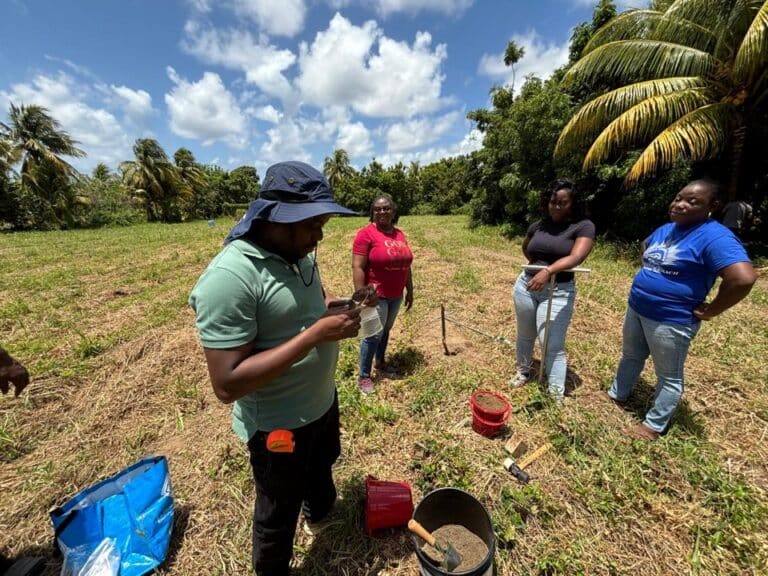
The opening of a tree nursery, the use of more efficient wood burning stoves, the planting of improved varieties and the construction of a poultry farm are some of the actions carried out under this inspiring project.

Port-au-Prince, Haiti, December 18, 2014 (IICA). Arreguy is a rural community in Haiti with a population of around 16,000, situated in the southeast of the country, in the hills surrounding the city of Jacmel. Since arriving there in 2002, the Missionary Sisters of St. Laura have not only devoted themselves to pastoral activities but also to social work and community development.
Their concern for the environment, coupled with the work of volunteers in the area, gave rise to the project Reforestation and Use of Energy Saving Stoves in Arreguy-Jacmel, Haiti, which is receiving technical and administrative assistance from the Inter-American Institute for Cooperation on Agriculture (IICA) and financing from Spain’s Caritas Diocesana de Bilbao (CDB).
IICA’s involvement in the community of Arreguy, through the Missionary Sisters, dates back more than ten years. The Institute’s programs have focused on a number of issues, including food security, support for animal production and loans for women. It has also mobilized resources for the construction of classrooms in the school run by the nuns, and other donations from Haiti’s private sector.
In 2011, at the request of the Missionary Sisters, IICA submitted a project proposal to Caritas Diocesana de Bilbao for the implementation of a two-year pilot project entitled Reforestation and Use of Energy Saving Stoves.
The proposal was approved and the two parties signed a technical cooperation agreement for its implementation, with a budget of USD 230,000. The success of the first phase, executed over a 27-month period, led to approval of a three-year extension or second phase with a budget of USD 514,000.
During the first phase of implementation, the work focused on the following activities:
• Establishment of a community nursery to produce fruit and forest tree species.
• Construction and distribution of more efficient wood burning stoves.
• Agricultural activities designed to increase production and thereby improve food security.
• Establishment of a poultry farm to produce eggs.
• Implementation of a broad training and sensitization program on reforestation and its importance. The materials used were prepared in creole.
The results of all the components were excellent. However, in order to make the initiative sustainable and ensure the community’s ownership of it, a three-year extension was requested that CDB approved.
The goal of the second phase is to consolidate the activities implemented under each component during the first two years and focus on two additional components:
• Support for grassroots organizations (community development) and
• Assistance to rural women by means of a credit mechanism based on the Kredifam methodology.
Over the next two years, the project aims to strengthen the community’s ownership of the project and build the capacity of grassroots organizations, to enable them to assume responsibility for the development of the community.
Another goal is for the organizations to promote income-generating activities designed to improve the quality of life of the population of Arreguy-Jacmel.
Cristina Gonzalo, Head of CDB Projects, explained that “cooperation between IICA and Caritas Diocesana de Bilbao under this project is helping to reduce the use of firewood for cooking, raise the population’s awareness of the importance of reforestation and environmental conservation, and boosting production and food security.”
Gonzalo added that the Project had been made possible thanks to “the support of hundreds of thousands of Biscayans who have backed the implementation of a specific project that is benefiting women, young people and the grassroots organizations of the community of Arreguy.”
Alfredo Mena, IICA Representative in Haiti, pointed out that “the collaboration with this donor has been very important, to ensure that the actions that IICA has been carrying out with the counterpart, the Missionary Sisters of St. Laura, are sustainable.”
More information:
alfredo.mena@iica.int
Components of phase 1:
The community nursery and reforestation
Construction and distribution of more efficient wood burning stoves
Agricultural activities designed to increase production and thereby improve food security