
Lloyd Day, Deputy Director General of IICA; Martial Bernoux, Senior Natural Resources Officer at FAO within the Office of Climate Change, Biodiversity and Environment; Sophie Beecher, Director General of Agriculture and Agri-food Canada; Nick Blong, First Assistant Secretary for Sustainability and Climate at Australia’s Department of Agriculture, Fisheries and Forestry; Karen Ross, Secretary of the California Department of Food and Agriculture; and Paul Luu, Executive Secretary of the “4 per 1000” initiative.
Belém do Pará, Brazil, 24 November 2025 (IICA). Representatives of the governments of Canada and Australia and the California Department of Food and Agriculture visited the pavilion of the Inter-American Institute for Cooperation on Agriculture (IICA) at COP30 to draw attention to the importance of soil health.
Only healthy soils can guarantee resilient agrifood systems, and that is why the issue must be included in all national strategies for tackling climate challenges. So said the participants in a panel discussion that was a focus of particular attention at the Home of Sustainable Agriculture of the Americas. IICA had its own pavilion in Belém do Pará, the fourth consecutive time that it had taken part in the annual meeting of the world’s largest environmental discussion forum, following its participation in the COPs held in Sharm El Sheikh, Dubai, and Baku.
The participants in the event included Sophie Beecher, Director General of Agriculture and Agri-food Canada; Karen Ross, Secretary of the California Department of Food and Agriculture; Nick Blong, First Assistant Secretary for Sustainability and Climate at Australia’s Department of Agriculture, Fisheries and Forestry; and Paul Luu, Executive Secretary of the ‘4 per 1000’ initiative, which seeks to strengthen the role of agriculture, and in particular soils, in the climate discussion.
The moderator was FAO’s Martial Bernoux.
IICA Deputy Director General Lloyd Day welcomed the participants and members of the audience, and gave details of the Living Soils in the Americas program that IICA has been implementing since 2020 under the leadership of scientist Rattan Lal, head of the Lal Center for Carbon Management and Sequestration at Ohio State University (OSU), and which has already achieved concrete results in various countries in the region.
The discussion in the IICA pavilion focused on public policies and the private sector projects being carried out in Canada, the State of California, and Australia, a country that is also a major food producer and exporter.
Results and consensus
Beecher explained that soil health underpins all agricultural policies implemented in Canada. “The Department of Agriculture was the first department created within Canada’s government, which says a lot, and it has always worked to protect the soil”, she said.
The official added that Canada has been enjoying remarkable success with the implementation of good practices such as crop rotation and the use of cover crops, which is reflected in the scientific indicators on soil health and in increased productivity.
“We believe the most important thing is to build a shared vision with regard to priorities, one that includes indigenous communities, civil society organizations, academia, and, of course, farmers’ associations. And in Canada, we have a very strong consensus on the importance of soil health. We also have a number of politicians who have highlighted the issue. We are determined not to miss this opportunity”, Beecher remarked.
Karen Ross referred to the policies implemented in California aimed at sustaining agricultural productivity and opportunities for rural communities, emphasizing that these are considered priorities for her state.
“We have ambitious goals and farming is always on the table in political discussions”, she observed.
The official spoke about promoting climate-smart agriculture and practices linked to the conservation of natural resources.
“The soil”, she explained, “can be part of the solution to climate challenges, through carbon sequestration. But it’s also about changing the narrative and societal perceptions. If we invest in soil health, we ensure continued productivity and farmers’ survival”.
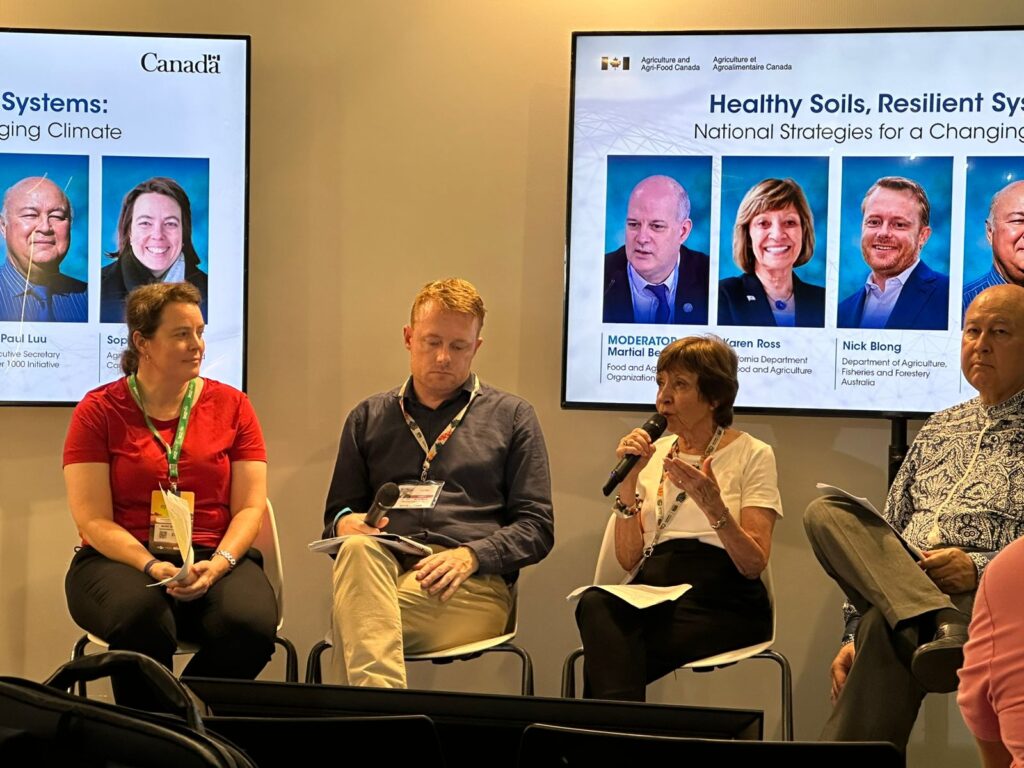
Representatives of the governments of Canada and Australia and California’s Department of Food and Agriculture participated in the event at the IICA pavilion during COP30, highlighting the importance of soil health in tackling climate challenges.
Nick Blong presented Australia’s 2021-2041 National Soil Strategy, a 20-year plan whose three key objectives are to: prioritize soil health, improve innovation and soil management, and strengthen knowledge and capabilities with regard to soils. “We have a huge responsibility as far as land use is concerned because we are major food exporters and our country is very diverse, with tropical agriculture in the north and cold areas in the south”, he said.
Paul Luu, an agronomist specializing in tropical agriculture, spoke about the relationship between soil health and water, and how land degradation and chronic droughts have led to desertification in large areas of France.
Professor Luu heads up the “4 per 1000” international initiative launched by France at COP21 in 2015, which aims to demonstrate that agriculture, and in particular agricultural soils, can play a crucial role in food security and in tackling climate challenges.
More information:
Institutional Communication Division.
comunicacion.institucional@iica.int