The document was prepared by the countries of the region, with the support of the Executive Secretariat of the Central American Agricultural Council (SECAC), the Central American Dairy Federation (FECALAC) and IICA.
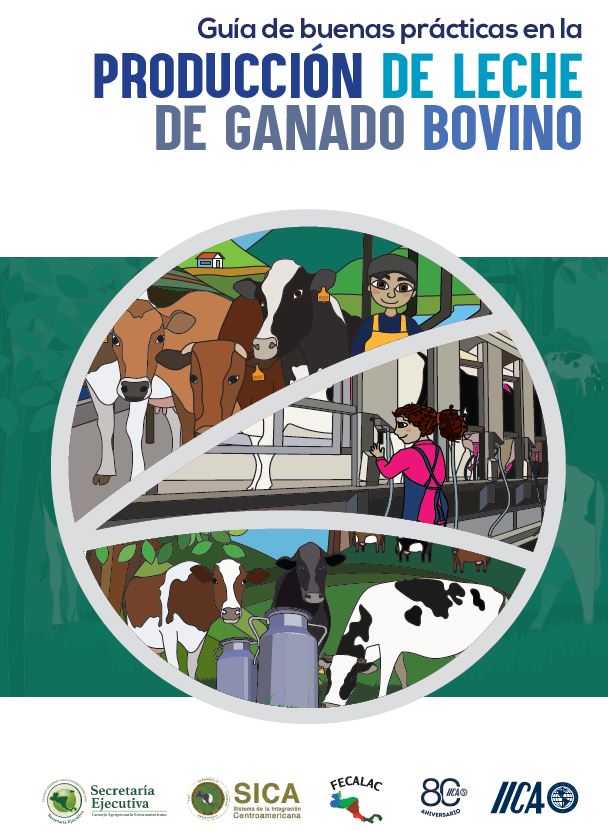
San Jose, 30 September 2022 (IICA). The dairy sectors of Central America and the Dominican Republic can now access a new guide that will facilitate the safe production of milk and its related products, thereby protecting public health, animal well-being and the environment.
The publication is the Guide to Good Practices in Cow’s Milk Production, which was developed by the countries of the region, with the technical support of the Inter-American Institute for Cooperation on Agriculture (IICA), the Secretariat of the Central American Agricultural Council (SECAC) and the Central American Dairy Federation (FECALAC).
The document includes input from public and private entities in Belize, Costa Rica, El Salvador, Guatemala, Honduras, Nicaragua, Panama and the Dominican Republic. It was created to address a need expressed by the region’s dairy sector to strengthen basic production in the chain, as the basis for the improved safety and quality of milk and its byproducts.
The new instrument, which is available for download from the IICA repository (in Spanish only), promotes good agricultural practices in relation to the location and operation of dairy cattle establishments; animal housing and facilities; animal origin, identification and traceability; the water, feed and health of the cattle; veterinary drugs and related products; and all aspects related to milking, storage and transportation of milk; product quality; and finally, staff health and hygiene.
Its application will enhance the competitiveness, development and sustainability of the dairy sector and it represents a regional public good that promotes the safety and quality of milk and its related products.
The guide was launched at an event at IICA Headquarters in San Jose, Costa Rica, in the presence of authorities from the Dominican Republic’s Ministry of Agriculture, SECAC, FECALAC and IICA.
Víktor Rodríquez, director of the ministry’s Office of Agricultural Trade Agreements, explained that, “Historically, the dairy sector has played a highly important social, environmental and economic role in our countries, and equally so in the development of rural areas and small agricultural economies. This is a paramount issue for food and nutritional security. In implementing this guide, we must collaborate and capitalize on best practices, standardize and strengthen intraregional trade”.
The document was prepared through a participatory process, with the dairy and dairy product organizations, as well as public institutions, contributing their expertise in national and regional consultation workshops.
Alejandra Díaz, IICA Specialist in Agricultural Health, Food Safety and Quality, explained that, “We analyzed a variety of regulatory and voluntary information, as well as research, on effective measures that can help to minimize or mitigate health, animal and environmental risks at the primary production level”.
“The entire Central American dairy sector should feel very satisfied. This was a three-year, consensus-based effort. Now begins the challenge of implementing the guide in each country, with everyone’s support. We also need continued support from IICA, SECAC and other entities to develop other instruments that will help us to improve our competitiveness, productivity and performance”, said FECALAC president, Álvaro Coto.
According to Érick Montero, Technical Coordinator of FECALAC and Executive Director of Costa Rica’s National Chamber of Milk Producers, Central America has almost 246,000 dairy farmers, 4.5 million dairy cows, 322,526 dairy farms, an industrial processing capacity of more than 1.7 million liters per year, 275 major dairy companies at the regional level, as well as 3,548 artisanal and formal industries.
More information:
Institutional Communication Division.
comunicacion.institucional@iica.int