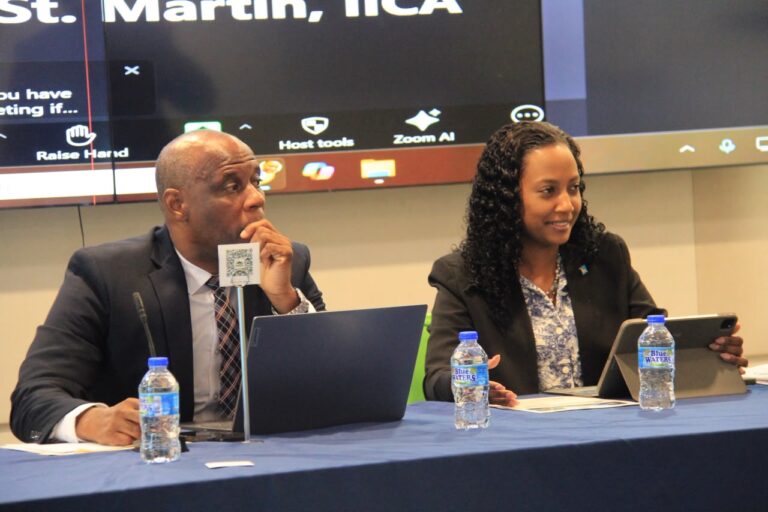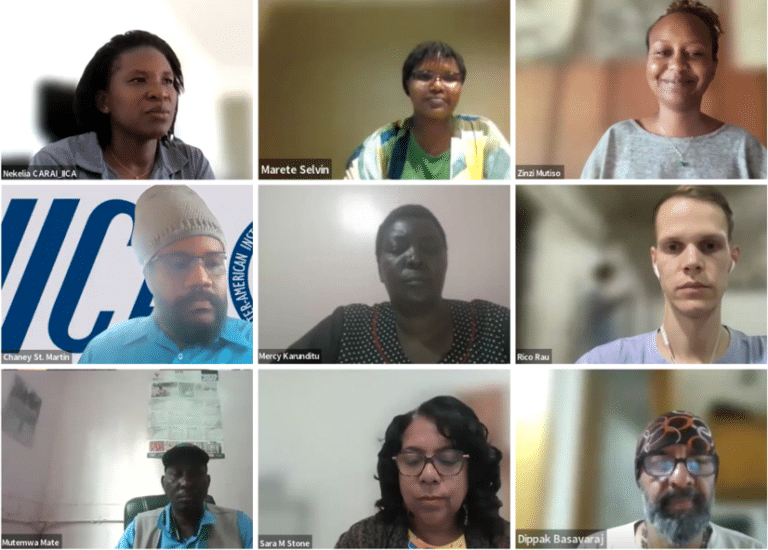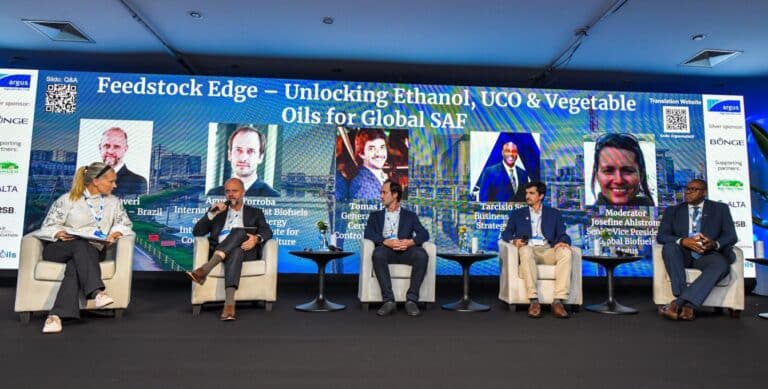
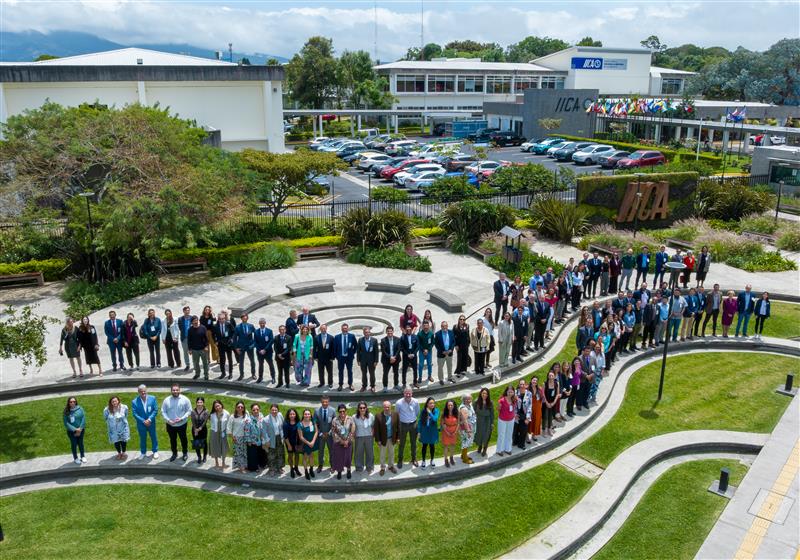
The Conference held at IICA is the meeting point for members of the Latin American Bioeconomy Network, created in early 2023 as a collaborative space for the region’s leading bioeconomy stakeholders and promoters.
San José, 15 May 2025 (IICA) – The bioeconomy is the most powerful path to transform agriculture, agri-food systems, and rural territories in Latin America, agreed the authorities who participated in the opening ceremony of the 2025 International Conference of the Latin American Bioeconomy Network, held at the headquarters of the Inter-American Institute for Cooperation on Agriculture (IICA).
They also stated that the potential of the bioeconomy as a tool for the sustainable development of the region will be achieved through the full use of science, technology, and innovation.
More than 150 people from various countries in the region and the rest of the world are participating in the meeting, including public authorities, business leaders, academics, researchers, and representatives of international cooperation organizations.
The event comprises four days of dialogue, discussion, analysis, networking, and strategic planning for the bioeconomy in Latin America, and also aims to build bridges with the bioeconomy in the rest of the world.
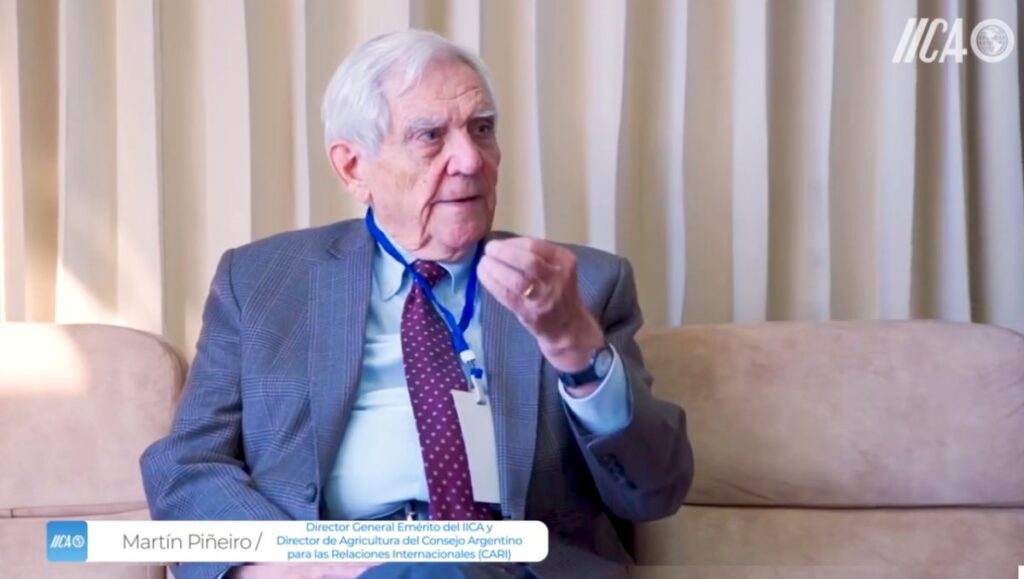
“Our task is to build bridges between production and the environment, and the bioeconomy is a development model for this—for generating economic growth and social development—knowing that bioproduct markets are expanding much faster than traditional ones. We are facing a huge opportunity, since our rural areas are major biomass-producing basins,” said IICA Director General Manuel Otero.
The Conference held at IICA is the meeting point for members of the Latin American Bioeconomy Network, created in early 2023 as a collaborative space for the region’s leading bioeconomy stakeholders and promoters. IICA serves as the Secretariat of the Network, which currently brings together over 80 institutions from 14 countries.
Also participating in the Conference are institutions leading bioeconomy initiatives in other countries and regions, as well as in major international forums.
Joachim von Braun, Professor of Economics and Technological Change at the Center for Development Research (ZEF) at the University of Bonn, Germany, and IICA Goodwill Ambassador, was one of the speakers in the first plenary session, which addressed key global perspectives in science, technologies, and bioeconomy markets.
He was joined by Brazilian expert in Bioeconomy and Innovation Eduardo do Couto, in a session moderated by IICA’s Director of Technical Cooperation, Muhammad Ibrahim.
“We are living in a unique moment in history. Advances in life sciences, biotechnology, synthetic biology, and digitalization are opening up opportunities that were unimaginable just a few years ago,” said Ibrahim.
IICA’s Director of Technical Cooperation also stated that the bioeconomy presents an opportunity to rethink “how we produce, how we consume, and how we interact with the planet. If we use and replicate biological processes in our productive activities, and apply knowledge, we can undoubtedly build more sustainable economies and more inclusive social models.”
The UNESCO Representative in Costa Rica, Alexander Leicht; the Executive Director of the Amazon Cooperation Treaty Organization (ACTO), Edith Paredes; and IICA Deputy Director General Lloyd Day participated in the opening ceremony. Immediately afterward, IICA’s Manager of Innovation and Bioeconomy, Hugo Chavarría, presented the objectives of the Conference.
Knowledge generation
Professor von Braun spoke in his presentation about the future of the bioeconomy and its connection with technological, social, organizational, and political innovation.
“The bioeconomy of the future is based on technological, social, and political innovations. From new biotechnological applications to social initiatives in agriculture and local energy, and adaptations in governance structures, the bioeconomy offers sustainable and inclusive solutions,” he stated.
He also noted that bio-based innovations will transform cities, with wooden buildings, algae panels for energy, and bio-inspired architectural designs. “These urban solutions will reduce the rural-urban gap and promote a circular economy,” predicted the expert, who served as Chair of the Scientific Group convened by the UN Secretary-General for the 2021 Food Systems Summit.
Lloyd Day stated that the bioeconomy makes it possible to integrate the new frontiers of knowledge with local and ancestral wisdom to transform the continent’s abundant biomass and rich biodiversity into products and services that promote greater employment and income opportunities for both businesses and rural communities.
“Our region holds more than 50% of the world’s known biodiversity and is the largest exporter of biomass. However, these comparative advantages do not translate into competitive advantages. We still discard a lot of waste and add little local value. Furthermore, we continue to rely on extractive models that do not create value chains in the territories. We need to wake up as a region,” he said.
Speaking on behalf of UNESCO, Alexander Leicht stated that science and innovation must play a central role in addressing the challenges facing humanity.
“UNESCO supported the creation of the Latin American Bioeconomy Network. As a specialized science agency, we believe in the need to advance scientific diplomacy. We are at a crucial moment, as humanity faces a combination of interconnected crises, and science is essential to confronting them. The response to most of these challenges lies in the generation of science-based knowledge that is accessible to all,” he said.
Edith Paredes spoke about the importance of the bioeconomy for ACTO, which brings together eight countries (Bolivia, Brazil, Colombia, Ecuador, Guyana, Peru, Suriname, and Venezuela) and is the only socio-environmental bloc of nations dedicated to the Amazon.
“The Amazon rainforest,” she warned, “is in a very alarming situation. ACTO has the diplomatic and political mandate of its eight members, with a very specific instruction: to avoid the point of no return by placing life at the center. In that sense, the economy for sustainable development, or bioeconomy, must be an inclusive and fair approach. It is not an alternative path, but the way forward, the engine we must use for the socio-economic and environmental development of this biome.”
More information:
Institutional Communication Division.
comunicacion.institucional@iica.int