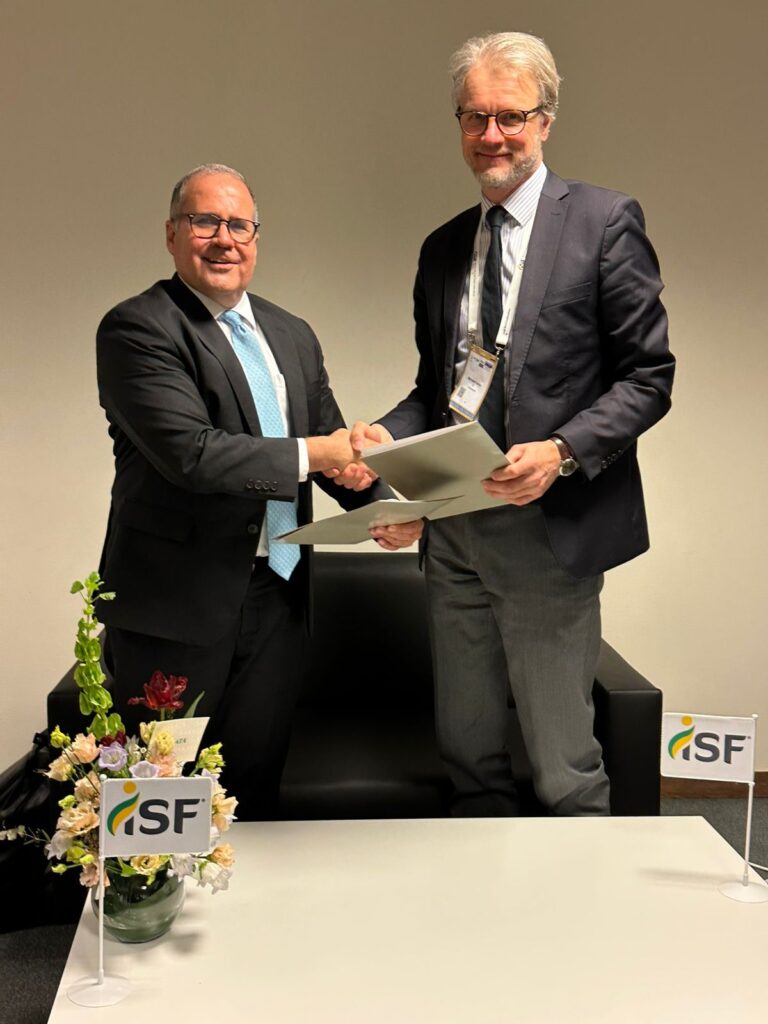
IICA Deputy Director General Lloyd Day, and ISF Secretary General Michael Keller.
Istanbul, Turkey, 22 May 2025 (IICA). At this year’s annual meeting of the ISF World Seed Congress, the seed industry’s most important global forum for technical and political dialogue, the Inter-American Institute for Cooperation on Agriculture (IICA) and the International Seed Federation (ISF) signed a strategic cooperation agreement aimed at transforming the seed trade into a vector of sustainable development, innovation, and food security for the Americas and the world.
The document was signed by IICA Deputy Director General Lloyd Day, on behalf of Director General Manuel Otero, and ISF Secretary General Michael Keller. This partnership establishes a precedent for collaboration between international organizations and the private sector, aimed at consolidating a more resilient, innovative, and equitable agricultural ecosystem.
The agreement establishes a collaborative framework that will make it possible to implement joint actions aimed at facilitating international seed trade, harmonizing regulatory frameworks, and promoting scientific and technological innovation applied to plant breeding.
The two organizations committed to speeding up the adoption of modern biotechnologies, gene editing tools, and the use of digital platforms for seed traceability and certification. The agreement reflects a firm commitment to science, technology, and the integration of forward-looking public policies.
“Seeds are the starting point for any agricultural transformation. We have soil, we have water, but without seed innovation, we cannot respond to the climatic, social, and economic challenges facing agriculture,” Lloyd Day said during the ceremony.
Michael Keller remarked that: “This partnership with IICA represents a firm step toward a more innovative, inclusive, and resilient agricultural system. By integrating science, technology, and international cooperation, we are empowering farmers with better seeds and opportunities.”
The agreement between IICA and the ISF seeks to ensure that all farmers, from the smallest to the most technologically advanced, have access to high-quality genetic material that allows them to produce more, better, and sustainably, thus contributing to higher agricultural productivity and conservation of the environment and biodiversity.
One of the cornerstones of this partnership is the strengthening of participatory plant breeding and capacity building in science and technology among young professionals, technicians, and rural producers. The aim is to promote a new generation of seed producers skilled in applied genomics, precision agriculture, and agricultural bioinformatics, as part of a comprehensive vision for agrifood sustainability.
The partnership also supports the implementation of regional technical agreements aimed at regulatory harmonization, which will streamline the exchange of seeds between countries, reduce trade barriers, and improve phytosanitary surveillance systems.
IICA Seed Network
This new agreement is aligned with the work of the IICA Seed Network, a technical platform that promotes the production, certification, and distribution of quality seeds across the hemisphere, linking research centers, governments, businesses, and producer organizations.
In line with this strategy, IICA has consolidated agreements with key entities such as the Argentine Seed Association (ASA), the Seed Association of the Americas (SAA), the International Seed Testing Association (ISTA), and the Peruvian Seed Association (APES). It is also advancing new partnerships with the American Seed Trade Association (ASTA) and the International Union for the Protection of New Varieties of Plants (UPOV).
The incorporation of the ISF strengthens this ecosystem of international cooperation that is committed to making agriculture more resilient to climate change, with greater technological and productive inclusion.
More information:
Institutional Communication Division.
comunicacion.institucional@iica.int