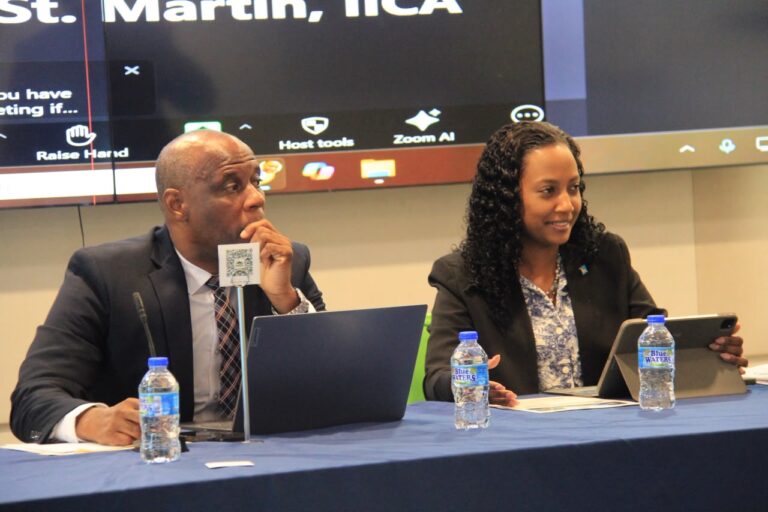

Belém do Pará, Brazil, 19 November 2025 (IICA) – Stakeholders from the Central American Dry Corridor, one of the world’s most vulnerable regions to extreme climate events, shared their experiences at COP30 and discussed how to turn scientific knowledge into action to strengthen the resilience of agriculture and livestock production, ultimately improving the quality of life of rural communities.
The setting for the discussion was the pavilion of the Inter-American Institute for Cooperation on Agriculture (IICA) at the Belém do Pará conference, where governments from around the world—together with experts, other international organizations, the private sector and social and environmental movements—are debating, through November 21, how the global approach to the climate, economic and social challenges facing the planet should move forward.
The so-called Central American Dry Corridor is a strip running from southern Mexico to Panama. It covers 30% of Central American territory and is home to about ten million people, 60% of whom live in communities with incomes below the poverty line.
It is an area that experiences recurrent droughts as well as extreme rainfall, whose impact is intensified by poverty and the degradation of natural resources.
The region faces the difficult challenge of adapting without leaving anyone behind, and the tools to do so are knowledge and innovation. The task can only be addressed in a multidimensional way—connecting policies, institutions, environmental conservation, landscape restoration, access to finance and the creation of economic opportunities to improve agricultural resilience and strengthen rural communities, panelists at the IICA pavilion stressed.
The Tropical Agricultural Research and Higher Education Center (CATIE), an institution closely linked to IICA and headquartered in Costa Rica, is implementing the Escalar project. The initiative promotes low-cost, high-impact innovations accessible to small farmers. Its goal is to improve incomes for the community, generate local jobs and actively integrate youth and women.
It also seeks to help reduce climate vulnerability and strengthen production systems through inclusive, long-lasting and replicable changes.
CATIE’s Director General, Luis Pocasangre; Escalar project lead, Leida Mercado; Chiapas State Deputy Secretary for the Environment, Jorge Kanter; and World Vision’s Director of Climate Action for Latin America, Luis Corzo, joined IICA Director General Manuel Otero in a panel on the challenges and solutions for the Central American Dry Corridor at the Home of Sustainable Agriculture of the Americas during COP30.
Local knowledge and science
Pocasangre explained how the Escalar project works, noting that it already has 2,614 direct beneficiaries in the Central American Dry Corridor. “We understand that the local knowledge producers have is complementary to the science and research that develop technologies to address the problems faced by farmers in the field”, he said.
Through its coffee breeding program, CATIE has released five hybrid varieties—two of them drought-tolerant—that have already been successfully planted and harvested.
“Innovation and research can provide solutions. But we must be clear that farmers have to be involved from the very beginning in developing technological innovations. Scientists cannot do this work in isolation”, he warned.
Pocasangre lamented the weakening of agricultural extension systems in several countries: “In some countries, they simply do not exist. It is very difficult to bring technologies to the field in that situation”.
Manuel Otero, IICA’s Director General, noted that the Central American Dry Corridor is a particularly problematic region, characterized by subsistence agriculture and low productivity levels, which deepen poverty and exclusion and often result in migration.
“We must see how to transform threats into opportunities”, he said. “To do that, we need to empower smallholder farmers. We also need to create a new narrative—one that does not try to hide the vulnerabilities of the region, but rather highlights its positive aspects and potential, if we manage to ensure that science reaches the territories”.
Kanter described the work carried out by the State Council for the Restoration and Rehabilitation of Micro-watersheds in Chiapas: “We work directly with landowners in the territory. In Chiapas we have three types of land tenure: ejidal, communal and private. So there are small plots with many producers in the same area, which makes things a bit more complicated, but also pushes us to work collectively in order to move forward. We focus on nature-based solutions, regenerative agriculture and silvopastoral livestock systems. We know very well that if anyone is suffering from climate change, it is the farmers, who need support”.
More information:
Institutional Communication Division.
comunicacion.institucional@iica.int