Brasilia, 14 May 2025 (IICA). Rural producers should be at the forefront of the discussions, and it is vital that they join forces with key public and private sector stakeholders at the upcoming United Nations Conference on Climate Change (COP 30), due to take place in Belém do Pará, in order to position agriculture as part of the solution to the challenges facing the planet.
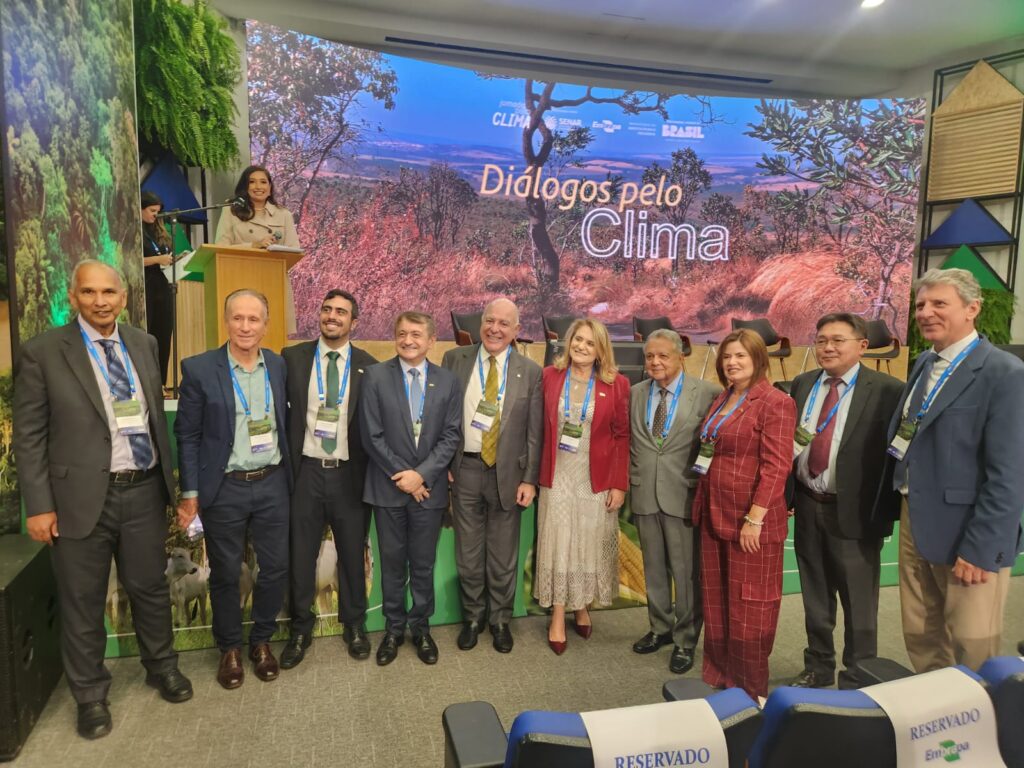
That was the message that the Inter-American Institute for Cooperation on Agriculture (IICA) delivered at the launch of the Climate Dialogues project, held at the headquarters of the Brazilian Agricultural Research Corporation (EMBRAPA) in Brasilia.
Under the aegis of the Climate Dialogues, EMBRAPA —a leading institution for research and the dissemination of new agricultural technologies, not only in Brazil but across the continent— will host a series of meetings in preparation for COP30, scheduled to take place from November 10 to 21.
Between now and October, events will be held in six different regions of Brazil to explore the Cerrado, Caatinga, Pantanal, Amazon, Pampa, and Atlantic Forest biomes.
At the launch, EMBRAPA’s President, Sílvia Massruhá, praised the institution’s partnership with IICA and highlighted the importance of bringing together leaders from different sectors. “The role of agriculture in the face of climate change,” she observed, “is an urgent and strategic issue, and one that has profoundly changed. The Dialogues are a call to action that requires collective solutions.”
Massruhá emphasized that Brazil can contribute, along with other countries, by sharing technologies that have transformed the country into an agricultural powerhouse. “The integration of crops, livestock, and forests, low-carbon agriculture, the use of bio-inputs, no-till farming, and biological nitrogen fixation are just some of the technologies that increase productivity that will be presented at COP 30,” she said.
IICA’s leading role
IICA’s Director of Technical Cooperation, Muhammad Ibrahim, was one of the speakers and presented the topic “Public and private alignment in the Americas to meet food production needs in the face of adverse climatic conditions.”
Ibrahim reminded the audience of IICA’s leading role at the last three COPs (in Egypt, the United Arab Emirates, and Azerbaijan), and confirmed that the Home of Sustainable Agriculture of the Americas will also be present at COP 30 in Brazil.
This will once again be the name of the IICA pavilion, where the public and private sectors, small farmer organizations, scientists, civil society, and international organizations will engage in dialogue and discuss the agenda of “agriculture as part of the solution.”
Integration of this kind has a single objective: to put producers at the center of the discussions, since they are the ones faced with climate impacts and who are continuing to find and apply solutions.
In this regard, Ibrahim explained that climatic variations affect food security.
“Production systems continue to be affected by these impacts, undermining farmers’ efforts and leading to lower productivity for several crops. To address this scenario, we are on the threshold of a new process of industrialization, based on biotechnology, digitalization, the circular economy, and local knowledge. The challenges are so great that no one can overcome them alone. Partnerships and collective action are needed,” he remarked.
Also taking part in the event was Roberto Rodrigues, former Minister of Agriculture of Brazil and an IICA Chair, acknowledged for his contributions to scientific knowledge and the resolution of problems that limit sustainable development in Latin America.
“Brazil has the capacity to lead the global transition toward regenerative, inclusive, and low-carbon agriculture. The idea is to bring everything we’ve done to COP 30 and defend Brazil’s role in the world, in food and energy security, climate change, and job creation,” he said.
During the meeting, IICA presented several of its initiatives aimed at the development of sustainable agriculture based on the integration of key players in science, technology and innovation, such as the Central American Program for Integrated Coffee Rust Management (PROCAGICA) and the Living Soils of the Americas Initiative, a joint undertaking with Ohio State University’s Lal Carbon Center, headed by scientist Rattan Lal.
Other actions were mentioned that are designed to develop, promote, and channel new technologies to young people and agritechs to foster the innovation ecosystem, such as Digital Agriculture Week, which will be held once again in September, and the Fab Lab.
More information:
Institutional Communication Division.
comunicacion.institucional@iica.int