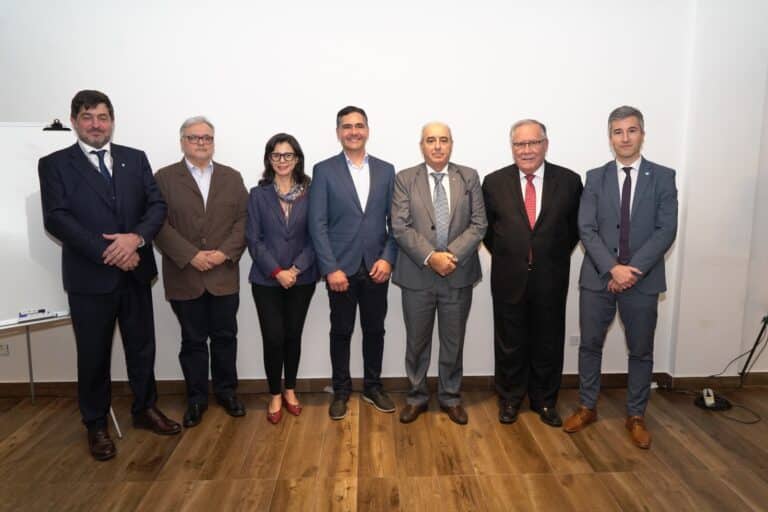
The Minister of Agricultural and Rural Development, Jhenifer Mojica; the Minister of the Environment and Sustainable Development, Susana Muhamad; the Deputy Minister of Environmental Land Management of the Ministry of the Environment and Sustainable Development, Francisco Javier Canal Albán; the President of the Rural Development Agency, Luis Alberto Higuera Malaver; the Director of National Natural Parks, Luis Olmedo Martínez Zamora; and the Rector of the National University of Colombia, Dolly Montoya, were among the officials who welcomed the Director General of the agency specializing in agricultural and rural development.
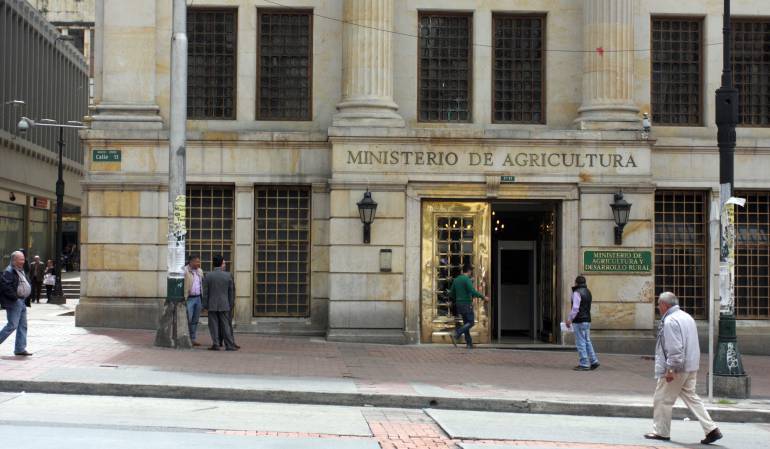
San Jose, 4 September 2023 (IICA) – During a recent visit to Colombia, the Director General of the Inter-American Institute for Cooperation on Agriculture (IICA), Manuel Otero, had a busy schedule of engagements that included meetings with high-level government officials aimed at strengthening the technical cooperation agenda with that country and its hemispheric projection through South-South cooperation initiatives.
The Minister of Agricultural and Rural Development, Jhenifer Mojica; the Minister of the Environment and Sustainable Development, Susana Muhamad; the Deputy Minister of Environmental Land Management of the Ministry of the Environment and Sustainable Development, Francisco Javier Canal Albán; the President of the Rural Development Agency, Luis Alberto Higuera Malaver; the Director of National Natural Parks, Luis Olmedo Martínez Zamora; and the Rector of the National University of Colombia, Dolly Montoya, were among the officials who welcomed the Director General of the agency specializing in agricultural and rural development.
He was also welcomed by Álvaro Calderón, Director of International Cooperation at the Colombian Foreign Ministry.
During Otero’s visit to Bogotá, IICA and Colombia agreed to advance the implementation of a joint agenda that will focus on the following topics: the agriculture sector’s transition towards greater sustainability, with special emphasis on the role of peasant farmers; respect for biodiversity as a key element in production activities; value-adding processes; the strengthening of topics related to the bioeconomy; digital agriculture and agricultural health.
The Director General of the hemispheric organization reported that the commitments undertaken by Colombia and IICA during his visit will be implemented through the signing of memoranda of understanding with each of the institutions.
Cooperation between Brazil and Colombia
As part of the South-South Cooperation agenda, which fosters collaboration between developing countries, a project was defined whereby technical specialists of the Colombian public sector will travel to Brazil to learn first-hand about that country’s progress in areas such as science, technology and innovation; territorial development; public procurement and supply systems.
The Colombian technical specialists will visit the capital, Brasilia, and the state of Bahia, in northeastern Brazil.
With support from the World Bank, IICA will implement the initiative, which will strengthen ties between the two countries through field activities.
Otero noted that, in addition to learning from Brazil’s experiences, Colombia will be able to share the progress it has achieved in the fields of sustainable agriculture and respect for biodiversity in the food production process.
In that regard, the Director General of IICA highlighted the structuring of peasant reserve areas, which act as a buffer against the irrational expansion of the agricultural frontier.
Peasant reserve areas benefit small-scale farmers who receive public lands that are not being utilized, thereby fostering peace and social stability in rural areas.
Among the immediate actions to be carried out as a follow-up to Manuel Otero’s visit to Bogotá is a course on the Bioeconomy and the Challenges of Biodiversity Protection. It will be delivered with support from the Directorate of National Natural Parks, the Ministry of the Environment and Sustainable Development and the National University of Colombia.
The need to protect the Amazon was addressed in all the meetings. There was consensus on the urgency of implementing actions to restore the rural landscape, with active participation by small-scale farmers and vulnerable groups, who are particularly affected by environmental degradation. In that regard, the meeting participants underscored the importance of supranational actions, given that the Amazon ecosystem is shared by several South American countries.
More information:
Institutional Communication Division.
comunicacion.institucional@iica.int