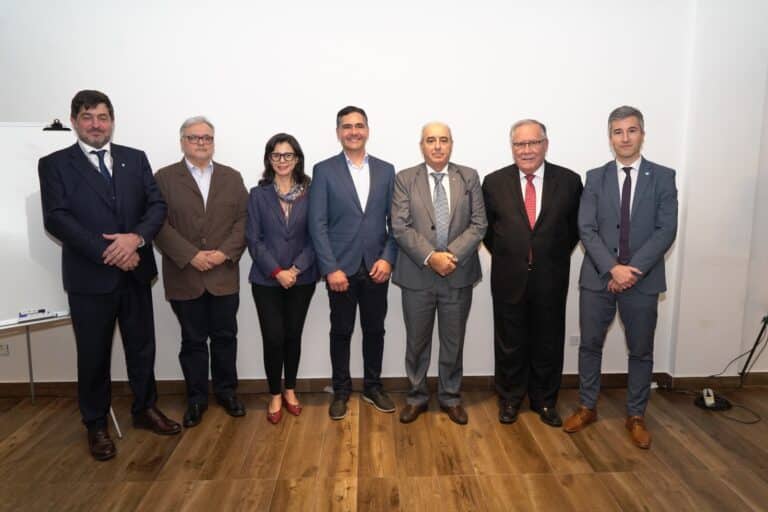
He attended the presentation of the Institute’s technical cooperation strategy for Chile and participated in an intersectoral dialogue on policies for addressing the rise in food prices.
Santiago, Chile, June 14, 2011 (IICA) The Director General of the Inter-American Institute for Cooperation on Agriculture (IICA), Victor M. Villalobos, visited Chile on June 8-9 to attend the presentation of the Institute’s technical cooperation strategy for that country and participate in the Subregional Seminar: Intersectoral dialogue on policies to address rising and volatile food prices: threats and opportunities.
While in Chile, the Director General met with the Minister of Agriculture, Jose Antonio Galilea, and with Alan Bojanic, Officer in Charge of the Regional Office of the United Nations Food and Agriculture Organization (FAO) for Latin America and the Caribbean.

The purpose of the Subregional Seminar, held on June 7-8, was to facilitate an exchange of experiences on the results of agricultural, trade, financial and social policies the countries have implemented in the last five years to address the threats and opportunities posed by rising and volatile food prices. It was organized jointly by ECLAC, FAO and IICA.
The meeting was attended by high-level representatives of the Ministries of Agriculture, Treasury, Economy, Finance, Foreign Trade and Development of Argentina, Bolivia, Brazil, Chile, Ecuador, Mexico, Paraguay, Peru and Uruguay. Also in attendance were directors of sectoral policy units (REDPA/CAS) and representatives of the public financial system and central banks, agricultural producer associations, the foreign ministries of the expanded MERCOSUR and international organizations such as World Bank, IDB, IFPRI, IFAD, WFP and the European Union.
During the event, the Director General presented the conclusions of Working Group 5: Potential for increasing food production in the short and medium terms.
Technical Cooperation Strategy of the IICA Office in Chile
The IICA Office in Chile was the site, on June 8, of the ceremony to present the Technical Cooperation Strategy of the IICA Office in Chile for 2010-2014.
The event was attended by Dr. Villalobos and Alvaro Cruzat, Under Secretary of Agriculture of Chile.
Also presented during the event was the accountability report on all the activities carried out in 2010.
For more information, contact:
agarcia@iica.cl