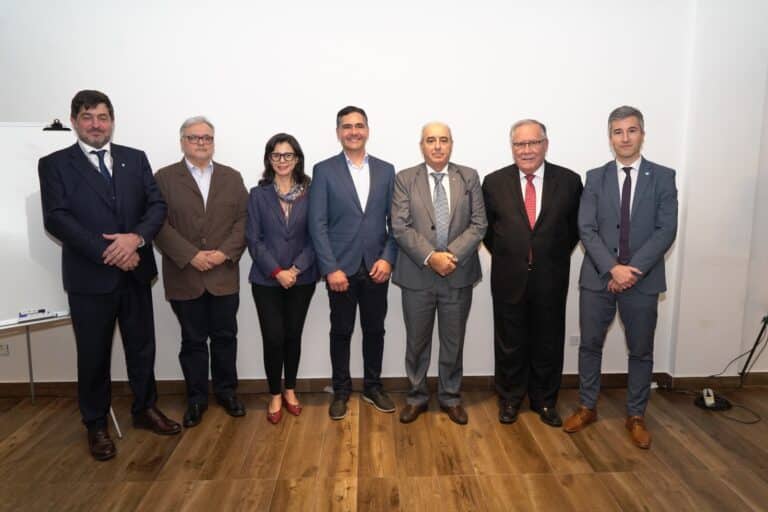
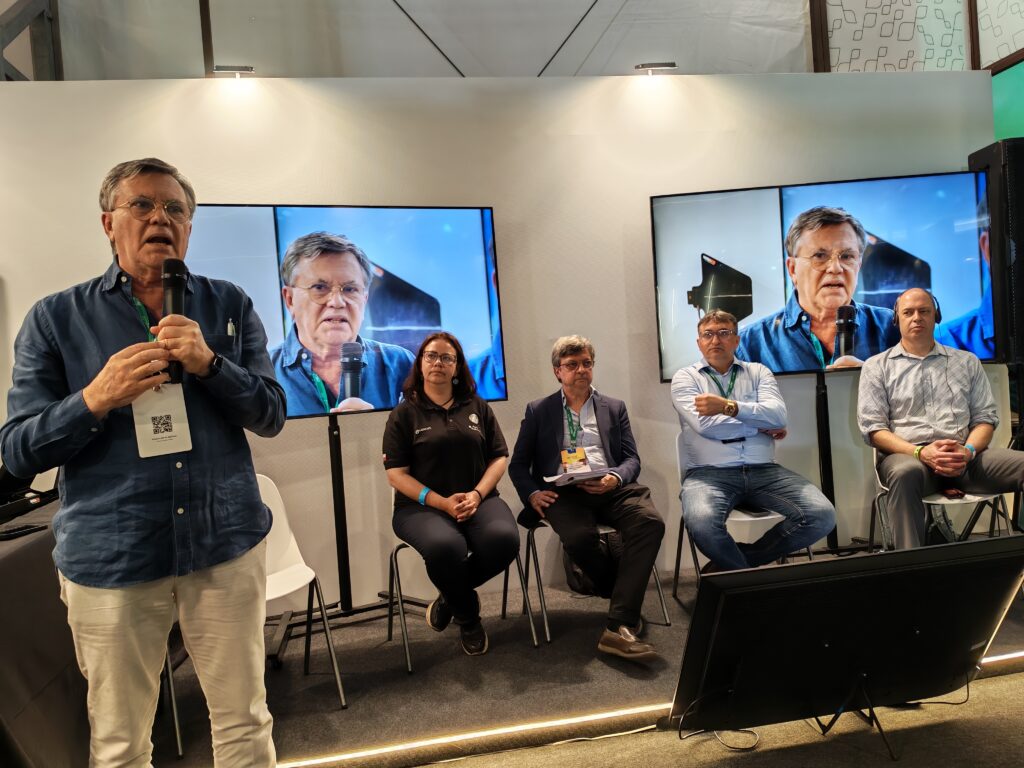
Manuel Otero, IICA Director General; Macarena Valdés, Leader of Rurality of the Americas; Marcelo Torres, President of AAPRESID; Walkymario Lemos, General Manager of the Eastern Amazon Region at EMBRAPA and Eric Mittenthal, Chief Strategy Officer at the Meat Institute / Protein PACT.
Belém do Pará, Brazil, 12 November 2025 (IICA) – Rural leaders, producer organizations and public authorities involved in agricultural research all agreed on the need for a new narrative to demonstrate how farmers in the Americas are transforming their activities, by way of science, technology and innovation, to become guarantors of the world’s food, energy and environmental security, while also increasing resilience and protecting biodiversity.
Featured in the panel discussion entitled “A New Narrative for Agriculture and Agrifood Systems of the Americas” were Manuel Otero, Director General of IICA; Eric Mittenthal, Chief Strategy Officer at the Meat Institute / Protein PACT; Walkymario Lemos, General Manager of the Eastern Amazon Region at EMBRAPA; Marcelo Torres, President of AAPRESID; and Macarena Valdés, proprietor of La Pachamama farm in Chile. The event was held at IICA’s Home of Sustainable Agriculture of the Americas pavilion, in the COP30 Agrizone in Belém do Pará.
Otero pointed out that, “One in every four tons of food produced in the world originates in the Americas, thus making the region a leading force in the planet’s food and environmental security. That figure is trending upward, thus providing an excellent opportunity to rewrite the narrative to demonstrate that farmers are the cornerstone of the science-, technology– and innovation-based transformation that is already underway in the rural areas of the hemisphere.
Marcelo Torres, President of the Argentine Association of Direct Seeding Producers (AAPRESID), explained that this new narrative should also provide a bridge between farmers, technology and public institutions in the agriculture sector.
He noted that, “Connecting the agenda of producers with high-tech operations and subsistence farmers is difficult, but the new narrative should serve as the basis for an interactive innovation network that includes all rural producers”.
Macarena Valdés, who was named an IICA Leader of Rurality of the Americas in 2022, along with her husband Marco Aceituno, explained how her business arose out of the need to feed her three children. It was an unsettling experience for the family, as they were not from a rural background and had never been involved in agriculture.
La Pachamama Farm is situated in Los Molles, Valparaíso, Chile, a region that has endured almost twelve years of water stress. Therefore, the couple had to learn about water harvesting and food production along the way. In other words, the crisis forced them to be innovative.
Macarena recalled that, “When we shared our innovations with the rest of the world, we realized that we could make a huge impact by telling others about the difficulties we had faced; how were able to produce 200 kg of hydroponic green fodder with only two liters of water, by implementing low-cost and easy-to-emulate innovations; and how we produce soils with manure and cardboard in a region where the soil consists of six centimeters of clay on rock”.
With IICA’s support, Macarena and her husband have visited countries in the Central American Dry Corridor to transfer knowledge on their innovations to rural producers in this area that is extremely vulnerable to climate conditions.
Successful innovation in agriculture
Walkymario Lemos, from the Brazilian Agricultural Research Corporation (EMBRAPA), pointed out the more than fifty-two-year contribution of his organization to agriculture in Latin America and the world. During that period, Brazil evolved from being a net food importing country to a global powerhouse in agricultural exports, based on research on tropical agriculture.
Lemos noted that, “In the current context, the five-decade science-, technology- and innovation-based agricultural revolution now requires a fourth pillar, which is communication. We need to communicate how agriculture in the Americas has changed, not only from a technological perspective, but in all aspects of the rural environment”.
Furthermore, he maintained that, “Thanks to EMBRAPA, Brazilian agricultural science is transforming resources into food and energy, while also protecting forests. Our researchers have sought to identify the most sustainable production systems for each region, therefore positively impacting the lives of our people”.
Eric Mittenthal, from the Meat Institute / Protein PACT, an entity whose membership consists of 95% of the meat producers in the United States, explained that his organization’s strategy was to provide details on the benefits of animal protein for human health.
“In the U.S., meat production is carried out in the most sustainable way possible, which is something that we communicate in a very transparent manner. We ensure that producers have reliable information, and given our knowledge of our consumers, we direct producers where to go to obtain the correct messages. Thus, we inspire trust when we tell our stories”.
More information:
Institutional Communication Division.
comunicacion.institucional@iica.int