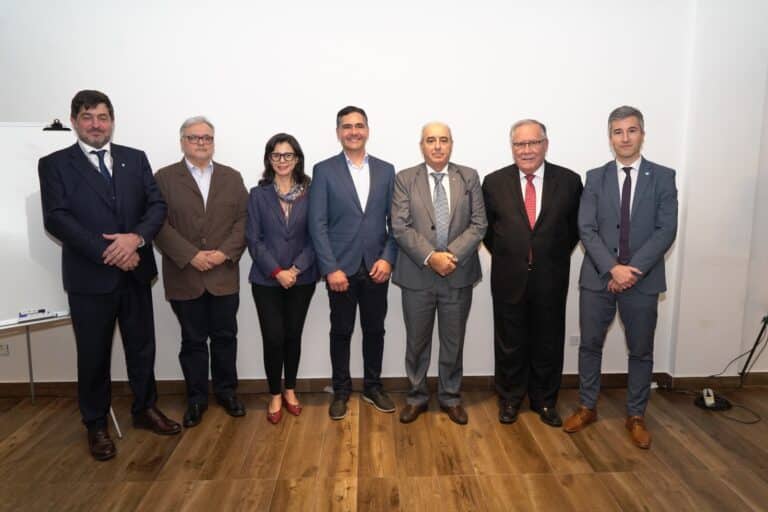

Santiago, 23 October 2025 (IICA). In the distinguished presence of Chile’s President, Gabriel Boric, the Inter-American Institute for Cooperation on Agriculture (IICA) and the Pan American Liquid Biofuels Coalition (CPBIO) took part in the discussions at the Tenth Energy Week in Santiago, Chile, on the technical, economic and regulatory challenges involved in accelerating the decarbonization of transportation in the Americas, especially in aviation.
At the event, organized by the Latin American Energy Organization (OLADE), Boric highlighted the fact that Chile obtains 70% of its electricity from clean sources, and the goal is to reach 100% by 2050.
“Energy is to the 21st century what trains were to the 19th century: an essential condition for development”, the Chilean President said.
“In Chile, we are tackling energy issues with a state policy that transcends governments and political affiliations. These issues must also be addressed in an intersectoral manner, because changes in the energy sectorimpact essential areas of life such as the education of children in our country”, the President added.
Chile’s Energy Minister, Diego Pardow, observed that the meeting “has been an opportunity to show Latin America and the Caribbean all the progress our country has made with clean energy and the energy transition: we have managed to put our house in order in terms of tariffs and wholesale market prices, which will allow the next administration to continue making steady progress towards meeting our decarbonization goals”.
The meeting also highlighted the strategic role of the Americas due to its agricultural, industrial and technological capacity to scale up sustainable energy solutions.
Agustín Torroba, IICA biofuels expertand Executive Secretary of the CPBIO, took part in the session on Latin America and the Caribbean’s potential to spearhead the development of sustainable aviation fuels, along with Angelo Gurgel of the Massachusetts Institute of Technology (MIT), Heloisa Borges of Brazil’s Energy Research Office (EPE) and Juan José Toha of LATAM Airlines.
“Brazil is forging ahead with the Fuels of the Future program, which integrates biodiesel, HVO, sustainable aviation fuels (SAFs), biomethane, ethanol and CO₂ capture and storage into a coherent energy transition strategy that acknowledges the strength of biofuels. Brazil remains committed to a policy that combines innovation and energy security with decarbonization”, Borges remarked.
“Decarbonizing aviation is a necessary but challenging task. SAFs are an important option for decarbonization in Latin America, but other measures will be required to achieve net-zero emission goals, such as improvements in operational and air traffic efficiency, aircraft fleet renewal, alternative propulsion methods and carbon offsets and removals”, Gurgel explained.
The expert also stated that the unification of decarbonization approaches in Latin American countries will ensure competitiveness and economies of scale,and prevent carbon emission leakage.
The prices of SAFs will be at least double the current price of jet fuel, so government policies and regulatory mechanisms will be required to attract SAF investments to the region and make them commercially viable, while balancing this against the impact of decarbonization measures on passenger demand and connectivity.
“In the short and medium term, we will see the large-scale development of sustainable aviation biofuels,and probably sustainable maritime biofuels, and to develop them, agricultural value chains will be vital. In our region, sugarcane, corn, soybeans, rapeseed and palm will continue to be key raw materials for producing sustainable biofuels, while adding value to agriculture and generating quality green jobs”, Torroba concluded.
During the event, Andrés Rebolledo was re-elected Executive Secretary of OLADE for the period 2026-2029, in recognition of his leadership in regional energy integration and institution building efforts within the organization.

More information:
Institutional Communication Division.
comunicacion.institucional@iica.int