San José, 29 September 2025 (IICA). With a view to strengthening food security and promoting sustainability and transparency in the agricultural supply chain, a group of technology leaders from academia, government, and the private sector explained why the digitalization of the agrifood sector is urgently needed to revolutionize traceability,from production through to final consumption.
The meeting took place within the framework of Digital Agriculture Week (DAW), organized by the Inter-American Institute for Cooperation on Agriculture (IICA) at its Headquarters in San José.
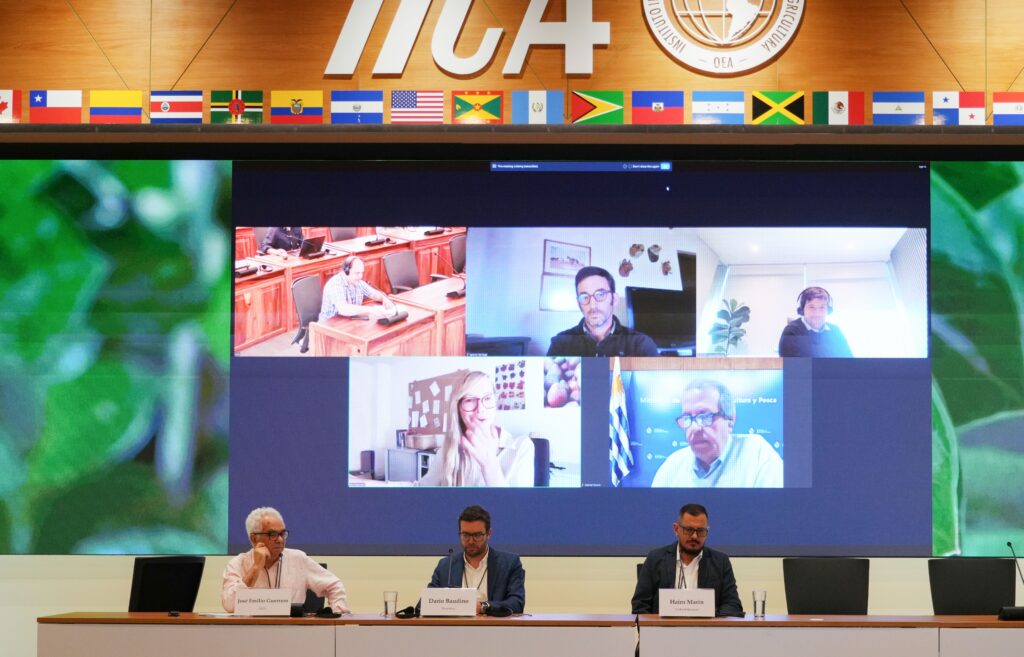
José Emilio Guerrero, a professor from the University of Córdoba in Spain, emphasized that “we need to make food healthier and more sustainable for the planet, and information and communication technologies have a key role to play in helping us achieve this”.
Eva-Marie Meemken, an assistant professor from the Department of Environmental System Sciences at the Swiss Federal Institute of Technology in Zurich, highlighted the shortcomings of traditional approaches to agricultural data collection, saying that “digital approaches offer things that conventional approaches cannot”, such as objectivity in measurements, improvements in the speed, frequency, and scope of monitoring, and lower costs.
She pointed out that while traditional approaches rely on self-reported data and on-farm surveys, these can be inaccurate and lead to delays in data collection. While the digital approach does require an initial investment and continuing expenditure, Meemken explained, “digital monitoring is gaining importance and creates opportunities and challenges that call for stakeholder action and global partnerships”.
Technological innovations that make a difference
Among the highlights of the event, Gabriel Osorio, Director of Uruguay’s National Livestock Information System, presented a digital traceability model that enables producers to electronically manage sworn declarations and brand renewals, monitor their establishments, and view animal records. This system facilitates data analysis and supports monitoring and the visualization of information in real time.
Francisco García Mansilla, head of FAS origination at Viterra Argentina, mentioned that digitalization tends to turn commodities into specialties, particularly in a context of growing sustainability requirements for agricultural production. In this regard, he presented traceability initiatives that the company is implementing based on the integration of platforms currently used by producers, such as cloud-based data management systems and crop monitoring.
In the private sector, Darío Baudino, CEO of Tracestory, presented an innovative digital platform that uses satellite images to verify the origin of products and their traceability throughout the supply chain.
Hairo Marín Leito, a systems engineer from Ceiba Soluciones, a Costa Rican company that develops process management software for the agro-industry, commented on the low level of digitalization among small and medium-sized businesses in the sector, which results in weak traceability.
“Our proposal involves offering software with a modern web platform that integrates scales, weighing indicators, and LED technology to obtain the percentage of usable meat, providing useful information for the producer”, he explained.
Ignacio Iturriaga, co-founder of Digirodeo, presented several innovative tools for achieving complete traceability in cattle farming. These include an electronic chip for remote readings of each animal, electronic devices for counting and weighing animals, and a smart syringe for monitoring medications administered to cattle, ensuring they are clean when they arrive at the slaughterhouse.
Collaboration and public policies: key elements for the digital transformation of agriculture
DAW provided an opportunity for a panel discussion on a series of key conclusions that suggest the need for a collaborative approach and alignment among the various stakeholders in the agriculture and technology sectors. The panel members included José Emilio Guerrero, a professor from the University of Córdoba; Oriana Gómez, CEO of Visualiti; Mariana Vasconcelos, CEO of Agrosmart; Oliver González, head of Infoagro Global; Rodrigo Saldías, IICA Representative in Uruguay; Jeremías Lachman, from the University of Buenos Aires; and Vitor Mondo, from EMBRAPA.
The experts were agreed that the digitalization of agriculture should be driven by public policies designed to address the challenges facing the sector, and emphasized the need to work collaboratively, coordinating and integrating actions. “I am grateful to IICA for coordinating and generating the alignment of the different ecosystems. This is a tremendous opportunity. Integration can be a force, and I congratulate the organization”, Lachman concluded.
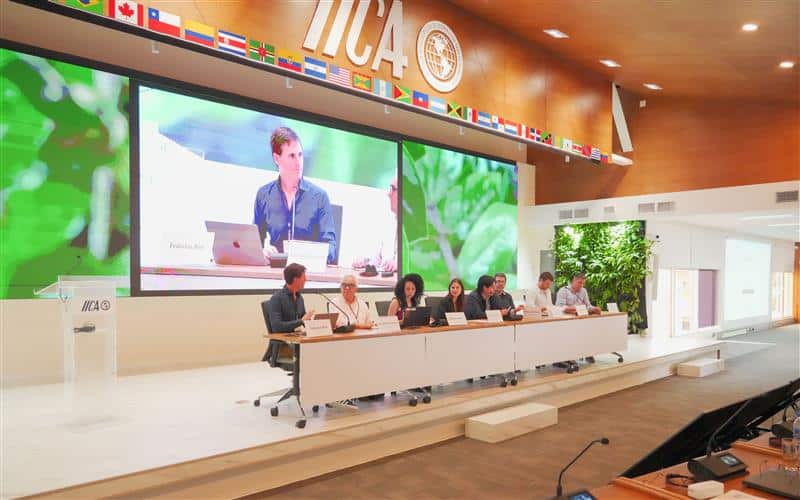
Federico Bert, Manager of IICA’s Agrifood Digitalization Program; José Emilio Guerrero, a professor from the University of Córdoba; Oriana Gómez, CEO of Visualiti; Mariana Vasconcelos, CEO of Agrosmart; Oliver González, head of Infoagro Global; Rodrigo Saldías, IICA Representative in Uruguay; Jeremías Lachman, from the University of Buenos Aires; and Vitor Mondo of EMBRAPA.
AgTechs and IICA define regional roadmap
During the meeting, the representatives of AgTechs proposed core strategies for driving the digital transformation of agriculture in the Americas. Some of the actions mentioned include the development of a regional repository of technological solutions, the creation of a permanent political-technical forum with IICA and the ministers, and the construction of a regional marketplaceconnecting startups with investors and multilateral funds.
“The more we are aligned with a single voice, the further we can go, because all our voices have the same value”, said Oriana Gómez, CEO of Visualiti, who presented the five core strategies on behalf of the AgTech Network promoted by IICA since 2022.
More information:
Institutional Communication Division.
comunicacion.institucional@iica.int