High-level agricultural authorities of countries in the Northern Region of the Americas noted that technological innovation, transparency and joint work are key to boosting intraregional trade amidst the current health crisis.
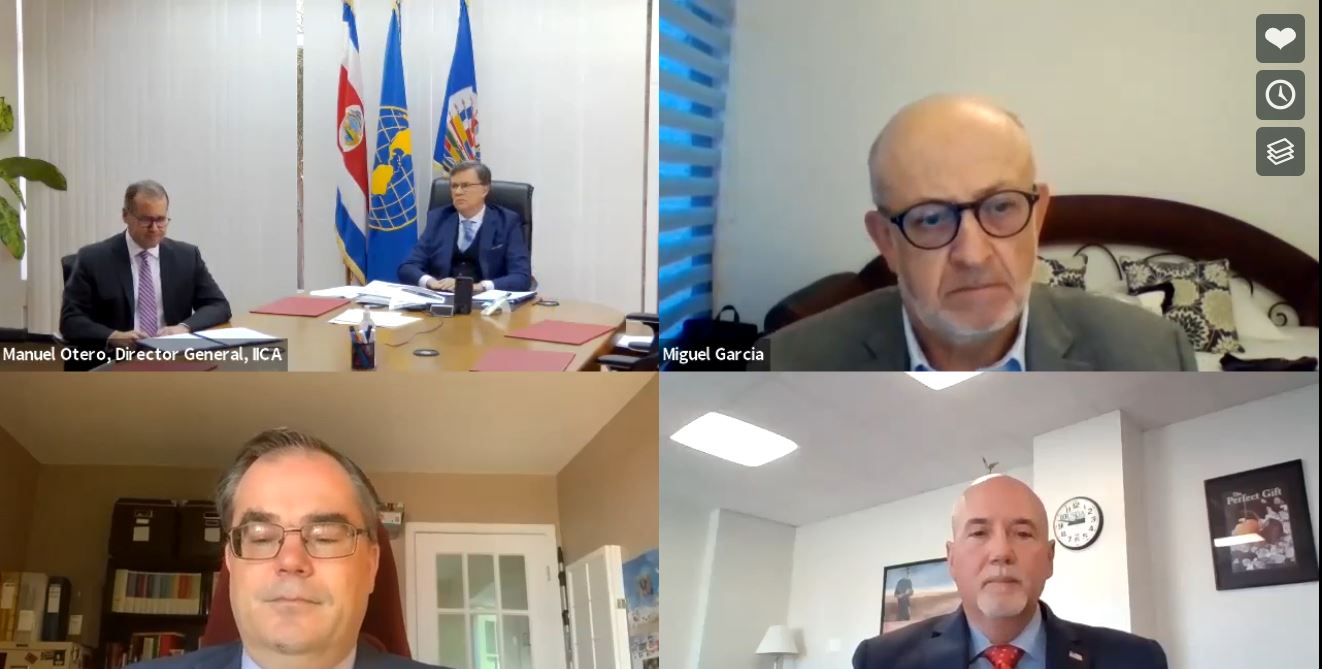
San Jose, 21 August 2020 (IICA) – During a high-level virtual dialogue organized by the Inter-American Institute for Cooperation on Agriculture (IICA), agricultural authorities from Mexico, the United States and Canada highlighted the ways in which intraregional trade can contribute to overcoming the challenges resulting from the Covid-19 pandemic. They also agreed that the trade agreement between the three countries, known as the USMCA, will contribute to bolstering economic recovery efforts in the wake of the health crisis.
During a dialogue with Manuel Otero, Director General of IICA, Frédéric Seppey, Assistant Deputy Minister of the Market and Industry Services Department of Agriculture and Agri-Food Canada (AAFC); Ken Isley, Administrator of the Foreign Agricultural Service of the United States Department of Agriculture (USDA-FAS); and Miguel García-Winder, Under Secretary of Agriculture of Mexico, discussed the influence of the USMCA on food supply and the role that multilateralism will play in the future.
“In 2019, agricultural and food trade with Mexico and Canada represented USD 48 billion and USD 45 billion, respectively. This means that these countries were the top two destinations for our agricultural and food exports that year”, stated Isley.
The participants agreed that, although the pandemic has generated new challenges, the USMCA has provided continuous support for trade, in which agriculture has played a leading role.
According to García-Winder, “the agreement has allowed for integrating the three countries’ agro-productive sector with companies that have subsidiaries in the other countries, thereby strengthening linkages within the agrifood chain”.
The regulatory framework established by the USMCA has served as a roadmap within the context of Covid-19, by incorporating requirements related to sanitary and phytosanitary aspects, transparency and labor rights.
“For the first time ever, the agreement addresses aspects that are crucial to agriculture, such as child labor and forced labor. The USMCA will play a very important role in reducing these issues”, he added.
According to the specialists, these challenges have worsened during the pandemic and jeopardize the progress achieved by the agreement over the past two decades.
“Amidst the Covid-19 pandemic, countries are tempted to focus on their own food supply; however, we must maintain the flow of trade to guarantee global food security, health and the well-being of all people. As we begin to overcome the pandemic, trade will play a crucial role in our economic recovery”, stated Seppey.
“Commitment is not the only thing that matters in a trade agreement. The degree to which it drives collaboration between governments and between businesses is also important”, he added.
Boosting innovation
Another aspect that Seppey, Isley and García-Winder highlighted was the urgent need to foster technological innovation in agriculture, not only in their own countries, but also by supporting other nations that supply the world with food, particularly Latin America and the Caribbean.
They noted that Canada, the United States and Mexico have bolstered their sanitary and phytosanitary protocols, which has contributed to greater biotechnological innovation. In their opinion, the development of advanced standards in this field could inspire other countries to adopt them.
During the virtual dialogue, reference was made to previous high-level dialogues between the Director General of IICA and renowned individuals, such as Rattan Lal, recipient of the 2020 World Food Prize, and Michael Kremer, winner of the 2019 Nobel Prize in Economics. The Institute’s permanent communication with ministers of countries throughout the hemisphere was also highlighted as an innovation mechanism.
“I believe that IICA’s response to Covid-19 has been very valuable to the region, and is a great example of coordination in addressing these situations. IICA provides a safe space to engage in necessary discussions, transfer information and work together”, remarked Seppey.
“We will need to address uncomfortable topics, but we can utilize platforms such as those offered by IICA to discuss these issues and generate solutions”, explained Isley.
Among the challenges cited was the impact of African swine fever on the agriculture sector in the Northern Region of the Americas. The participants considered that, by capitalizing on mechanisms like the USMCA, and with support from IICA, countries can work together to identify regional and global solutions.
“Our continent represents the future for humanity by guaranteeing food and nutritional security”, stated Otero.
“In Latin America and the Caribbean, intraregional trade is not substantial. As representatives of the Northern Region, you are setting a good example for other countries in the hemisphere”, he added.
Watch the complete webinar here:
More information:
Institutional Communication Division
comunicacion.institucional@iica.int