The Ministers of Agriculture of Bolivia, Colombia, Ecuador and Peru signed a Declaration presented during the most recent session of the Andean Agricultural Forum, organized with support from IICA. Inter-agency committees will support the fulfillment of the agricultural agenda proposed in the document (see Ministerial Declaration).
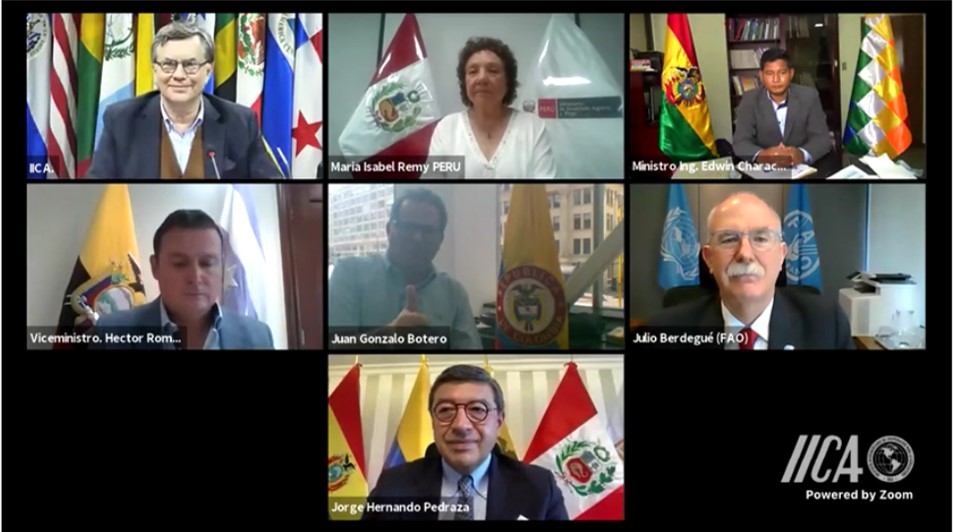
Bogota, 8 February 2021 (IICA). The member countries of the Andean Community of Nations (CAN) reaffirmed their commitment to the Andean integration process, which involves developing a proactive agenda to strengthen family farming and food security, as well as reactivate regional trade in the Andean region by promoting actions aimed at recovering markets, increasing sustainability, and strengthening competitiveness and agricultural productivity in the region.
To this end, the Ministers of Agriculture of Bolivia, Colombia, Ecuador and Peru signed a Declaration presented during the most recent session of the Andean Agricultural Forum, a forum for analysis and dialogue promoted by the Colombian Ministry of Agriculture with the support from the Inter-American Institute for Cooperation on Agriculture (IICA) and other organizations.
The declaration emphasizes the key role of family farming for the sustained, sustainable and integrated development of agriculture and rural areas in Andean countries, as well as the need to increase and diversify exports by overcoming unnecessary obstacles to regional trade.
The document also outlines the need to promote regional strategies for contract farming to improve market conditions for agricultural producers, as well as to strengthen family farming with an agroecological approach, recognizing its social, economic and environmental importance, as well as its contribution to food security. The document also underscores the need to take advantage of opportunities in the Andean subregion to meet the growing demand for food at the global level.
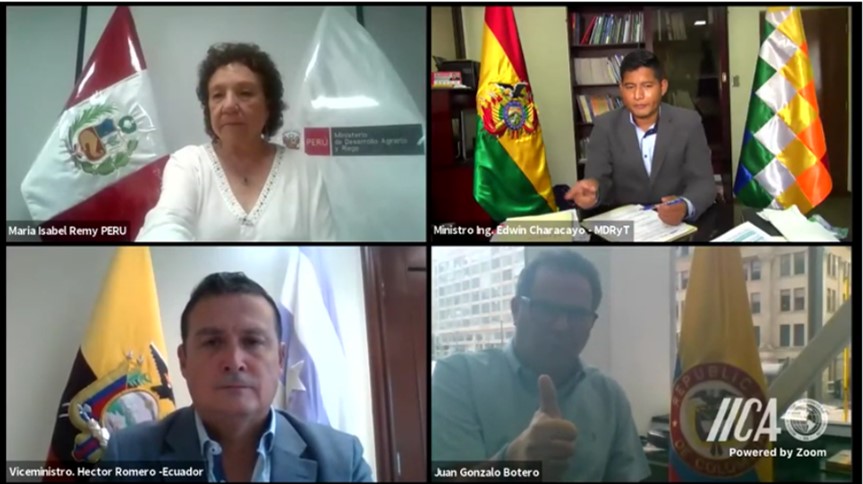
“The most important thing is that we commit to what has been resolved in this forum: to create an agenda that incorporates all of the contributions of the institutions, governments, agricultural leaders, civil society representatives and businessmen that have participated in this forum, ensuring that it all becomes a reality, rather than just a simple document”, remarked Héctor Antonio Romero, Deputy Minister of Rural Development of the Ministry of Agriculture and Livestock of Ecuador.
Romero added that it is important to follow up on the agenda, “working to strengthen CAN and our agricultural products, boosting quality and traceability, as well as strengthening domestic markets first so that we can overcome the challenges” of trade with third markets.
The various agricultural authorities in attendance also pointed out that it is crucial to implement a health diplomacy strategy and to harmonize sanitary and phytosanitary regulations to create common regulations and requirements. They also agreed on the need to join efforts to develop efficient and safe customs procedures for the clearance of goods, while automating, digitalizing and simplifying import and export processes and procedures.
“As we dream of a more prosperous region, I encourage you to undertake the commitment to adopt a forward-looking approach, to review and adjust joint proposals so that we can present ourselves to the world as a truly solid bloc with joint and aligned socioeconomic objectives. Our region must work together to consolidate productive actions for the development of our peoples and rural areas”, remarked Juan Gonzalo Botero, Deputy Minister of Agricultural Affairs of Colombia.
On the other hand, the Minister of Rural Development and Land of Bolivia, Edwin Charayo, commented that his country is seeking to “reinstitute the social, community and peasant model, with a focus on women’s inclusion as well as on-site assistance and verification to boost production and quality, in addition to providing producers with guarantees and security”.
María Isabel Remy, Deputy Minister of Agricultural Development Policy and Oversight of Peru, agreed, adding that, although it is very important to strengthen family farming and the leadership of women and youth, it is also necessary to “emphasize innovation and technology, which is crucial to boost our agricultural productivity; close gaps with respect to innovation and digital technologies that allow for strengthening food value chains and connecting producers to consumers; as well as boost efficiency and create jobs”.
Cooperation and integration committee
To strengthen the commitment to support the actions set out in the Declaration signed by the Ministers of Agriculture of CAN member countries, the Director General of IICA, Manuel Otero, proposed creating an inter-agency cooperation committee so that, “in coordination with the Andean Community of Nations, we can guarantee compliance with all of the political mandates established in the agricultural agenda that is emerging today”.
“Now is time for action, to rise to the occasion. This Agricultural Agenda will become our agenda”, stated the head of the hemispheric organization specializing in agriculture and rural areas.
Otero also underscored the importance of regional and interinstitutional collaboration, pledging to strengthen ties with entities such as the Food and Agriculture Organization of the United Nations (FAO) and other organizations with which it will “join forces, based on the understanding that now is the time for supranational cooperation to foster agricultural and rural development”.
At the end of the event, Jorge Pedraza, Secretary General of CAN, reiterated the commitment to “support all actions that will allow for transforming the declaration we have on paper into a reality, and ensuring that we will achieve a promising and better agriculture sector in a short amount of time”.
More information:
Institutional Communication Division of IICA
comunicacion.institucional@iica.int
Ministerial Declaration (available in Spanish only).