With support from IICA and other organizations, the Costa Rican cheese was granted the first designation of origin to be obtained by a Central American dairy product.
San Jose, Costa Rica, December 2012 (IICA). Santa Cruz and Santa Teresita, two towns situated on the slopes of the Turrialba volcano, midway between Costa Rica’s Central Valley and Caribbean coast, are renowned for their natural beauty, their inhabitants’ agricultural vocation, and, in particular, for the cheese they produce – recently granted the designation of origin ‘Queso Turrialba.’
Assisted from the outset by institutions such as the National University (UNA), the Inter-American Institute for Cooperation on Agriculture (IICA), the Ministry of Agriculture and Livestock (MAG), the National Agricultural Innovation and Technology Transfer Institute (INTA), AECID and FAO, it took the cheese producers of Santa Cruz and Santa Teresita, in the canton of Turrialba, over six years to secure recognition of the close links that exist between the geographical conditions of the area and their aromatic, flavorsome product, which they began to manufacture nearly 150 years ago.
“There are records of cheese being produced in Santa Cruz in 1870. It began to be sold in San Jose, the capital of Costa Rica, in 1950. After that, the fame of the cheese known as ‘Turrialba’ began to spread, due its specific flavor, aroma, and texture,” explained IICA agribusiness specialist Marvin Blanco.
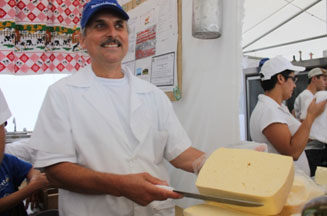
White and soft, Turrialba cheese continues to be produced using artisanal techniques. Modifications have only been made to the facilities, equipment, and basic utensils utilized.
Turrialba has also retained its charm: the volcano that stands 3339 meters above sea level, from which the region takes its name, is surrounded by pastureland and forests. Dairy cattle of breeds such as Guernsey, Jersey, Brown Swiss, and Holstein are reared in the area, as they are suited to the wet climate (annual precipitation averages 3000-3500 mm per year) and volcanic soils.
The book De la leche al queso, queserías rurales en América Latina, published by IICA in 2011 and coordinated by François Boucher and Virginie Brun, tells the story of the cheese factories of Santa Cruz. In the work, Blanco and UNA specialist Maricela Cascante explain what Turrialba cheese means to Costa Ricans: “In the artisanal plants, the milk is poured, unpasteurized, into square molds that produce cheeses weighing from 2-8 kg, from which chunks are cut for sale. In the mini-plants, the cheese is made from pasteurized milk. As that alters the flavor slightly, many consumers prefer the artisanal cheese.”
The designation of origin (DO) recognizes that the particular characteristics of Turrialba cheese are due, fundamentally and exclusively, to the geographical location where the cheese is produced. The DO is different from other schemes, such as geographical indication; the area in which the item is produced is only one of the factors taken into consideration.
The differentiation of agrifood products, based on characteristics linked to their origin, is one of the areas of work of IICA’s Agribusinesses and Commercialization Program. One of the program’s current projects aims to determine whether the DO is applicable to the breeding of lambs in a cross-border region of Brazil and Argentina. PROCISUR, Brazil’s EMBRAPA, and Argentina’s INTA are also involved in the project.
Costa Rica’s Turrialba cheese is now one of a select group of DOs in Latin America that include the Neuquen criollo goat and Tandil salami (Argentina), the wine of the Vale dos Vinhedos (Brazil), Veracruz coffee and tequila (Mexico), Marcala coffee (Honduras) and pisco (Peru).
“DO has stricter requirements, it must be shown that the product’s differentiating characteristics are closely linked with the territory,” Blanco said.
In Costa Rica, the DO was granted by the Registry of Industrial Property. At the global level, the certification is recognized by the World Intellectual Property Organization (WIPO). (OMPI).
Benefits for producers
The cheese makers who belong to the Santa Cruz Farmers Association (ASOPROA), the organization that promoted the DO certification process, will be the first to benefit financially from the outcome, along with others from Santa Cruz and the nearby town of Santa Teresita. Altogether, it will affect some 250 producers.
“Manufacturers in other regions will now be prohibited from using the name ‘Turrialba,’ so consumers will know for certain that products bearing the ‘DO Queso Turrialba’ logo are authentic, with the physical-chemical and sensory qualities on which their reputation has been based for decades,” ASOPROA stated in a press release.
In 2006, ASOPROA, the MAG, and the UNA submitted the DO application to the Registry of Industrial Property, based on the technical standards and quality and safety requirements that must be adhered to during the production of milk and the manufacture of cheese, as well as packaging and the transportation specifications.
The requirements also include the chemical, physical, and microbiological specifications for the milk and cheese involved. Leonardo Granados, a researcher with the INTA, helped draw up the specifications as part of his doctoral thesis.
Now that DO status has been granted, the cheese producers of Santa Cruz and Santa Teresita must set up a regulatory board to administer the name, whose duties will include guaranteeing that producers adhere to the standards required and ensuring that companies outside the area do not market cheese under the ‘Turrialba’ name.
“Government, academic and cooperation institutions should support this initiative. If successful, it could motivate other producers to undertake similar actions in order to protect their products with a territorial identity,” IICA specialist Blanco remarked.
For more information, contact:
marvin.blanco@iica.int
Más información:
marvin.blanco@iica.int